Network Layer: Control Plane#
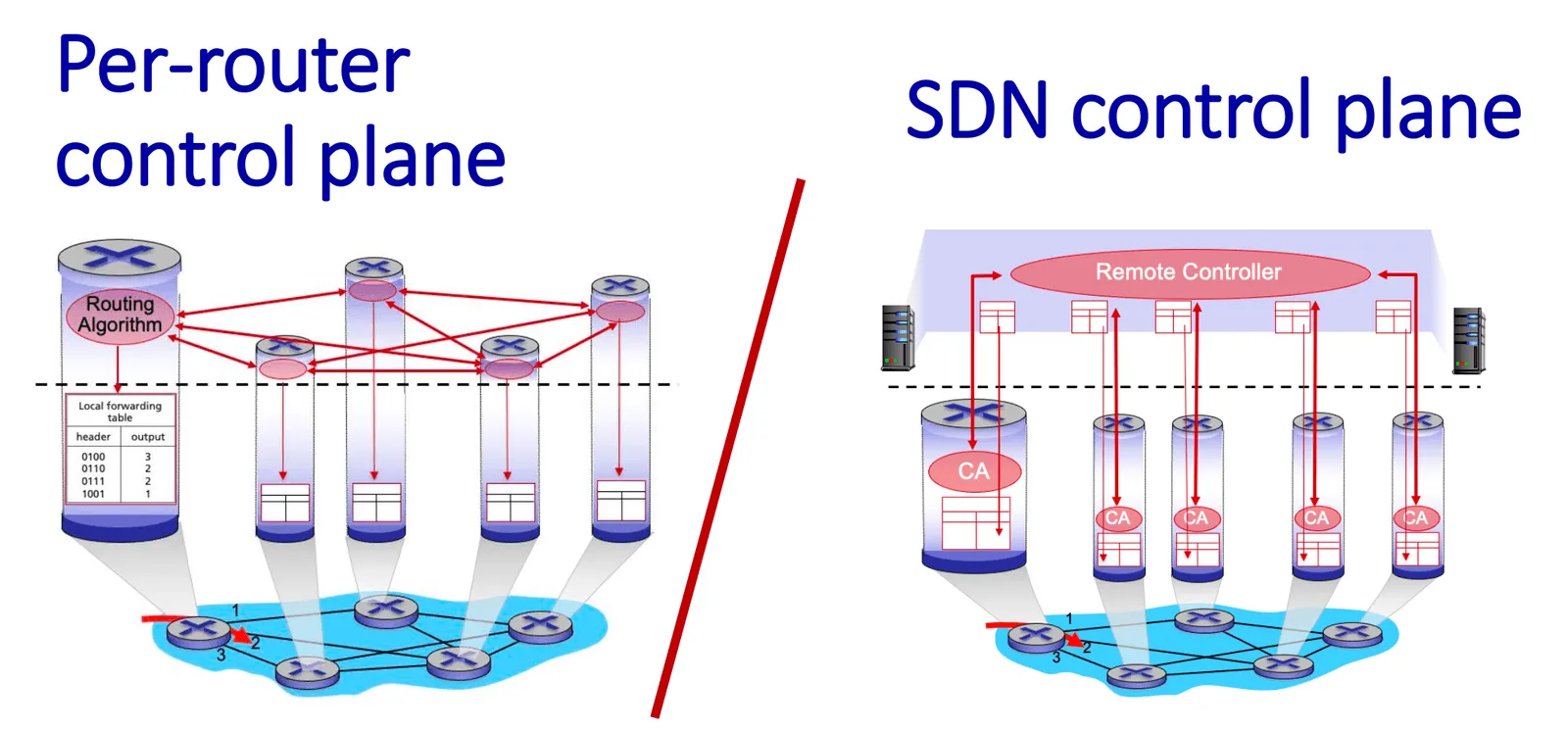
如何系統系的去管理網路,Control Plane 的設計概念,這章節講的就是所謂的 Routing 的動作,大致分為
- distributed per router
- SDN center control
Routing protocols#
通常可能有 cost, path, congestion 為指標來做判斷,在 P2P 的問題上課能會抽象化成一個 Graph shotest distance 的問題
可能會有以下幾個可以選擇的效果
- Global: 要知道所有的 router topology 資料
- Link State algorithm
- Decentralized: 只需要知道跟自己 physical connected 的 router 資料
- Distance Vector algorithm
- Static: 不太變動
- Dynamic: 隨時根據情況變動,週期性的改動
Link State Algorithm (Dijkstra)#
Notation
c(x, y): cost of walking directly fromxtoyD(v): the least cost from some source tovp(v): the predecessor of the path tovwith distanceD(v)N': the set of node thatD(v)has been decided
Algorithm
\begin{algorithm}
\caption{Dijkstra's Algorithm}
\begin{algorithmic}
\STATE \textbf{Initialization:}
\STATE $N' = \{u\}$ \COMMENT{compute least cost path from u to all other nodes}
\FOR{all nodes $v$}
    \IF{$v$ adjacent to $u$} \COMMENT{u initially knows direct-path-cost only to direct neighbors}
        \STATE $D(v) = c_{u,v}$ \COMMENT{but may not be minimum cost!}
    \ELSE
        \STATE $D(v) = \infty$
    \ENDIF
\ENDFOR
\STATE
\REPEAT
    \STATE find $w$ not in $N'$ such that $D(w)$ is a minimum
    \STATE add $w$ to $N'$
    \FOR{all $v$ adjacent to $w$ and not in $N'$}
        \STATE $D(v) = \min( D(v), D(w) + c_{w,v} )$
    \ENDFOR
    \STATE \COMMENT{new least-path-cost to v is either old least-cost-path to v or known least-cost-path to w plus direct-cost from w to v}
\UNTIL{all nodes in $N'$}
\end{algorithmic}
\end{algorithm}- 這個演算法 total time complexity 在良好的 implementation 下會是
Oscillations possible:在注意到這裡的所有 link cost 如果都是考慮 congestion 的部分,代表這裡的 link cost 其實有時候是 dynamic 的,可能會導致出現兩條路線都覺得 A path 比較好,那 A path 反而會出現 congestion,會產生震盪
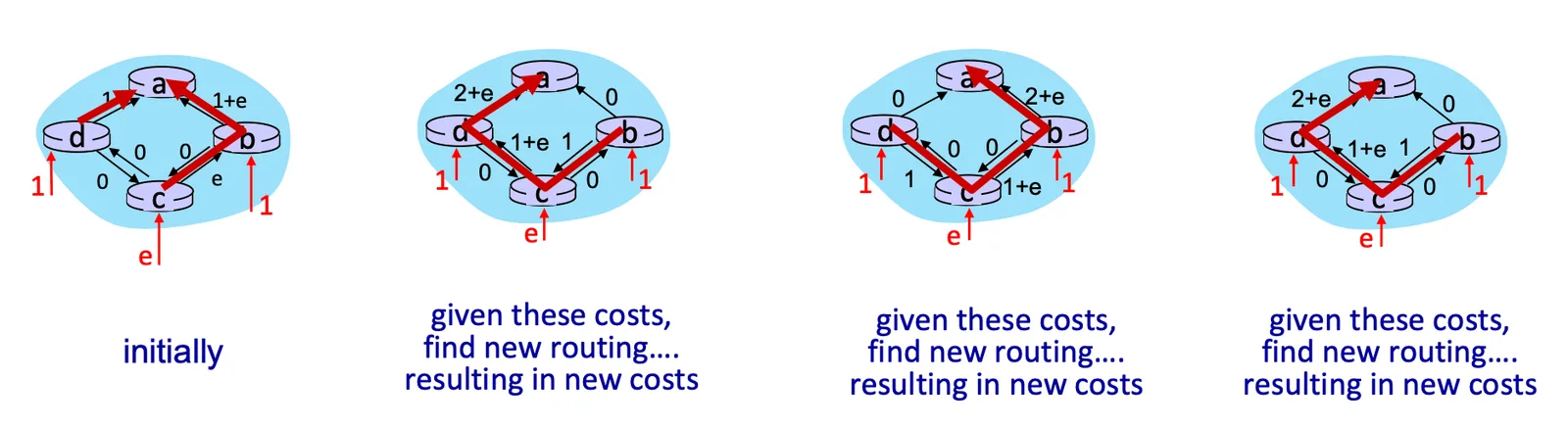
- 這個問題可以用中央統一的 controller 其實就可以做 load balancing
Distance vector algorithm (Bellman-Ford)#
根據 Dynamic programming 的方法去實作
- 從 x 走到 y 的最小 cost
- 在所有 x 的 neighbor v 加上 找到那個最小的值填進去
Diffusion Information#
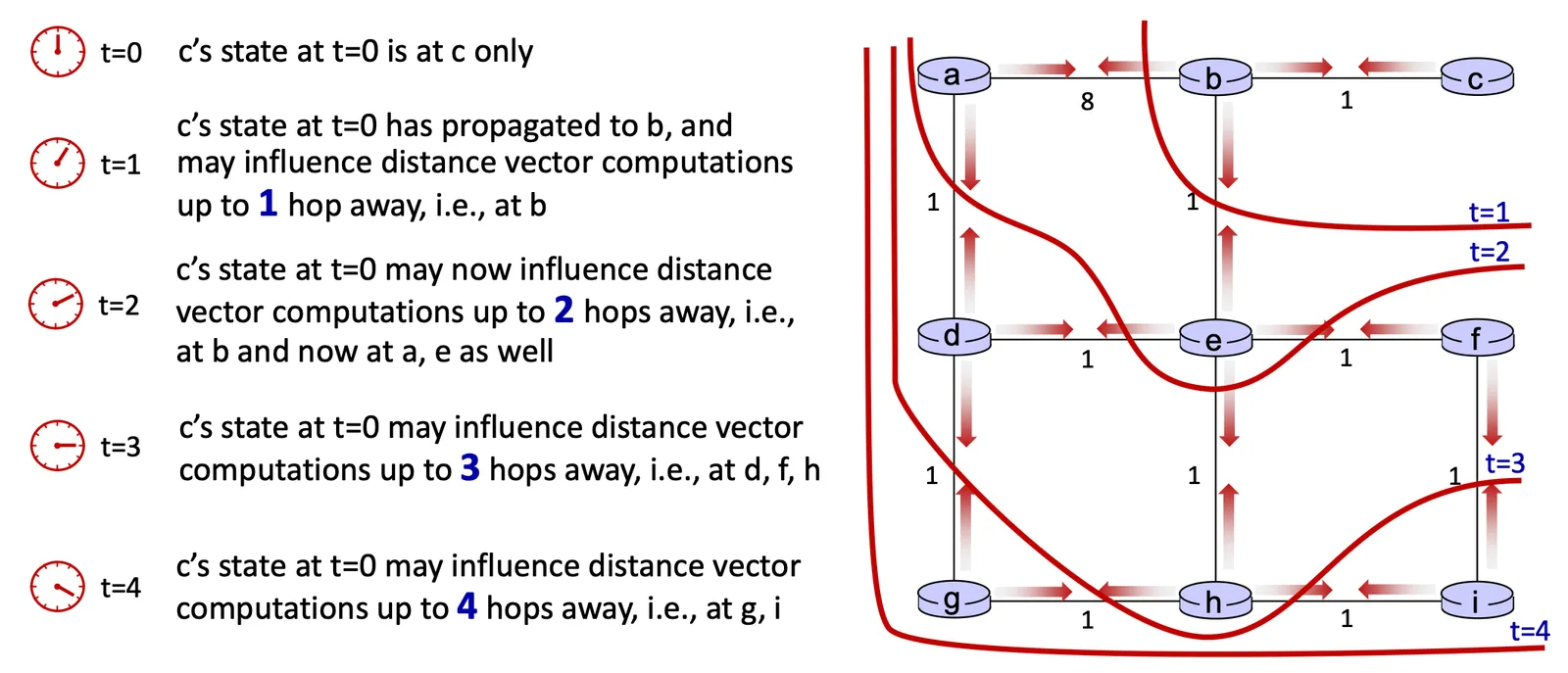
每個 router 都要跟其他人做 distance vector 做交換,如果網路狀況穩定,那就會收斂到最佳解,但如我是不停變動,那就會需要一段時間才能慢慢交換完成,需要擴散的時間
每個 node 都會
- wait for the
- change of local cost
- msg from other router
- recompute
- notify the neighbor
- back to 1.
link cost exchange#
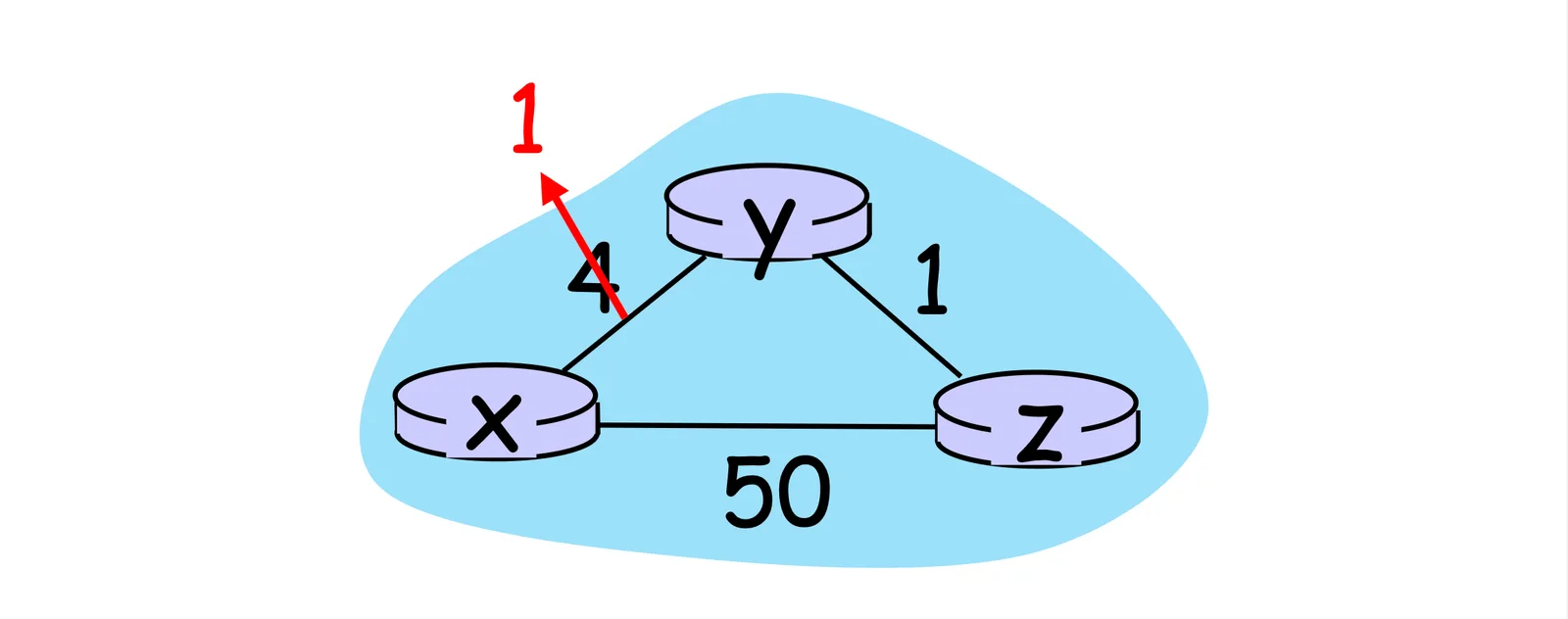
以這個圖為例子,我們只需要兩輪次就可以更新完成
- : detects link-cost change, update DV 然後通知他的 neighbor
- : 收到更改,update DV,重新計算 的最小 cost 然後送給
- : receives ’s update, updates its DV,發現沒有更動,停止這次的發送
這個步驟其實最主要是想確認一下別的 router 還活著
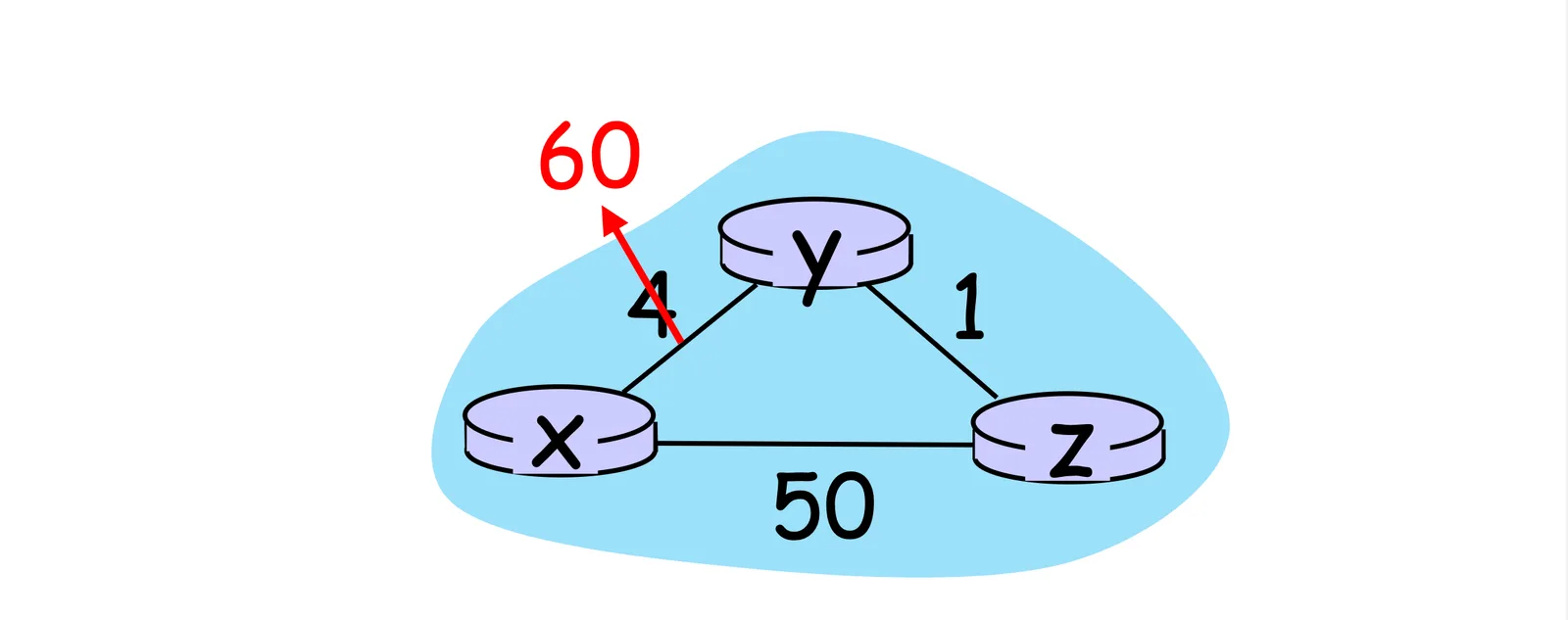
但是以這個圖為例子,我們總共需要 44 個 iteration 才能夠真正更新成一個 stable 的狀態,因為在還沒更新的時候,其實 y 根據 z 給的 DV 會覺得 x to y 可以透過 z 因為 z 覺得自己到 x 的 distance 是 (4+1),因為根本還沒更新到 z
因為 z to x 是 、y to z 是 ,更新完 DV (y to x 變成 6)通知他的 neighbor,接下來 拿到訊息,發現根據 DV z to x 最小可以是 z to y to x
持續這樣的過程,, 分別更新每次都 + 1 直到最後變成 stable 狀態是 51 才是正確的 DV,直到 z 發現 才會停下來。
Intra-ISP Routing: OSPF#
通常在一個真實的場景中,所有 router 的數量是 scale(極大)的,因此我們必須要採用其他的 Protocol 而非純粹計算 DV 或是 link-state
我們因此把同一個 ISP 或是同個 location 的 router 聚集起來稱為一個 “Autonomous Systems (AS)” 也就是俗稱的 domain,在這樣的前提下,我們把 protocol 分成兩種
- Intra-AS (domain): 在同一個 AS 中,決定 routing 的 protocol
- Inter-AS (domain): 在 AS 之間,決定 routing 的 protocol
Back to the content
NTU Computer Networking
2025 Fall
← Back to the content