Synchronization Examples#
Classic Problems of Synchronization#
Bounded-Buffer Problem#
採用 Producer-Consumer model 的時候,為了防止 Producer 在 buffer 滿的時候繼續寫,也不希望 Consumer 在沒有 data 的時候繼續讀,我們可以用 semaphore 的概念來完成 Bounded-buffer 的 requirement
假設我們有 個 buffers,並且每個 buffer 的大小都是 1,我們設定
- Semaphore
mutex來表示是否可以 access buffer,n 個 buffer 都用這個控制(binary),初始為1 - Semaphore
full有多少 buffer 裡面有東西,初始為0 - Semaphore
empty有多少個 buffer 是空的,初始為n
while (true) {
    ...
    /* produce an item in next_produced */
    ...
    wait(empty);
    wait(mutex);
    ...
    /* add next_produced to the buffer */
    ...
    signal(mutex);
    signal(full);
}比較不一樣的事要先等 empty 再等 mutex,我們先確定有位子,再去 access critical section,mutex 是為了保持 mutual exclusive 才做的,結束之後再 signal(full) 去 +1
while (true) {
    wait(full);
    wait(mutex);
    ...
    /* remove an item from buffer to next_consumed */
    ...
    signal(mutex);
    signal(empty);
    ...
    /* consume the item in next_consumed */
    ...
}剛好跟 Producer 相反
Readers-Writers Problem#
假設現在有好多個 process 再 concurrently 的 access 某個 data set,我們可以初步把他們分成兩種
- Readers
- 只會 read 不會 update
- Writers
- 可以 read 也可以 write
我們可以允許同時 multiple readers 一起 read 這個 data set,但只有一個 writer 可以 access 這個 data
當有 writer 在 access data 的時候,其他 reader, writer 也不能 access 這個 data
這類型的問題有一些變形,通常會牽涉到 priority 的問題,我們介紹三種
- First readers–writers problem:除非一個 writer 拿到 share object 的 permission,不然 readers 都不應該要 waiting,我們又叫他 reader-preference
- Second readers–writers problem:Writer 要有最高的 priority,想寫的時候應該要馬上可以寫,又稱 writer-preference
- Third readers–writers problem: no starvation
我們介紹 First readers–writers problem,首先我們需要定義
- Share data set
- Semaphore
rw_mutex(binary) 初始為1 - Semaphore
mutex(binary) 初始為1,拿來保護reader_count - Integer
reader_count初始為0紀錄 reader 數量
while (true) {
    wait(rw_mutex);
    ...
    /* writing is performed */
    ...
    signal(rw_mutex);
}在有 permission 的時候做,做完之後把 permission 還回去,很單純
while (true){
    wait(mutex);
    read_count++;
    if (read_count == 1) /* first reader */
        wait(rw_mutex);
    signal(mutex);
    ...
    /* reading is performed */
    ...
    wait(mutex);
    read_count--;
    if (read_count == 0) /* last reader */
        signal(rw_mutex);
    signal(mutex);
}首先需要更改 read_count 所以需要先拿到 mutex,然後我們分成兩個 case 討論
- 當 writer 未持有
rw_mutex時: 第一個 reader 必須先取得rw_mutex才能開始讀取,後續的 reader 則無需再次獲取即可直接讀取。讀取結束時,最後一個離開的 reader 需負責釋放rw_mutex,讓其他等待的 writer 得以繼續執行。 - 當 writer 已持有
rw_mutex時: 第一個 reader 會等待rw_mutex,而後續的其他 reader 則會等待 mutex。這是因為第一個 reader 必須成功取得rw_mutex後,才會釋放mutex讓後續 reader 進入。換言之,mutex除了保護read_count之外,也變相阻擋了後續 reader 在 writer 尚未結束存取前就進入讀取狀態。
只有最後一個 reader 會去
signal(rw_mutex),只有這時候會發生控制權轉換,而 writer 放掉rw_mutex後,接到 permission 的也可能是下個 writer 而非是 reader,也就是有可能會造成 starvation
Reader-Writer Locks#
這類問題的 solution 可以幫我們完成 Reader-Writer Locks,也就是我們提供不同 mode 的 lock
- Read mode: 可以允許多個 read mode lock 同時上在某個 data 上
- Write mode: 在一個 data 上只能一次有一個,因為要做 update
這樣的東西特別有用,我們可以做非常清楚的區分,哪些 process 需要 read, 哪些需要 write 就可以做 optimize,而 reader 多的 program 使用這種方法,雖然有 overhead,但 parallel 的 read 可以更有效率
Dining-Philosophers Problem#
假設有 5 格 philosophers,每個人左邊都有一隻筷子,必須拿到兩隻筷子才能吃飯,吃完要放回桌上

想成一個系統問題就是
- Share data (飯)
- Semaphore
chopstick[5](binary) 初始為1,但表這隻叉子現在是否可用
Semaphore Solution#
while (true){
    wait (chopstick[i]);
    wait (chopstick[(i+1)%5]);
    ... /* eat for awhile */ ...
    signal (chopstick[i]);
    signal (chopstick[(i+1)%5]);
    ... /* think for awhile */ ...
}用 semaphore 概念比較簡單,我們每次吃飯就需要自己旁邊的兩個 semaphore,所以就要拿他們兩個
這種方法有一個問題,如果在兩個
wait()之間有其他 process 先拿走了這個 process 需要的 semaphore,最後就會連環效應卡成一圈 deadlock
Monitor Solution#
monitor DiningPhilosophers
{
    enum {THINKING, HUNGRY, EATING} state[5];
    condition self[5];
    void pickup(int i){
        state[i] = HUNGRY;
        test(i);
        if(state[i] != EATING) self[i].wait();
    }
    void putdown(int i){
        state[i] = THINKING;
        // test left and right neighbors
        test((i + 4) % 5);
        test((i + 1) % 5);
    }
    void test(int i){
        if((state[(i + 4) % 5] != EATING) &&
            (state[i] == HUNGRY) &&
            (state[(i + 1) % 5] != EATING)
        ) {
            state[i] = EATING;
            self[i].signal();
        }
    }
    initialization_code(){
        for(int i = 0; i < 5; i++)
            state[i] = THINKING;
    }
}我們定義
- 三種 state
THINKING,HUNGRY,EATING,來區分我們他們的狀態 condition self[5]知道到底是在指哪個 process
而操作也有三種
-
pickup()就是試著要拿到 permission,先把自己的狀態設定成HUNGRY,再 calltest()如果發現自己狀態變EATING就可以執行,不行就等待,self[i]這時候就可以知道到底是哪個 process 在等 -
putdown()則是把 permission 放掉,讓左右鄰居去試試看他們有沒有要EATING -
test()必須要是 atomic operation,我們有兩種 call 這個 function 的情況- 某個 process
i想吃了 - 某個 process 剛做完,想知道他旁邊兩個有沒有要吃
當我們看到三個條件都滿足就可以讓自己的狀態變成
EATING,第一個第三個條件代表的是旁邊兩個 process 都沒有在EATING,第二個則代表自己想吃了 - 某個 process
構造完後我們就可以用以下方法調用
...
DiningPhilosophers.pickup(i);
/* eat */
DiningPhilosophers.putdown(i);
...這樣的方法不會有 deadlock,因為只有在左右都空的時候才能拿起 semaphore,但 starvation 還是可能發生的
Synchronization within the Kernel#
Synchronization in Windows#
Windows 的做法可以分成 kernel 裡面跟 kernel 外面來看,而 kernel 要 access global resource 的時候又可以分成 single processor 跟 multiprocessors
- Single processor: 直接把 resource lock 起來就好
- Multiprocessors: 用 spinlock 做 global 的 lock,在 windows 上 spinlock 只會用來保護比較短的區域,而且擁有 spinlock 的 thread 不會被 preempt
如果是在 kernel 外的 thread,則提供了 dispatcher objects,用了這個東西就可以順帶使用 mutex lock, semaphores, events, timers,來完成 synchronization
- 使用某個 resource 前要先 require 一個 mutex,結束後要歸還
- 使用 event 則比較像 condition variable,結束後會 trigger 某個事件
- Timers 用時間來決定
每個 dispatcher object 都有兩種狀態
- signaled
- nonsignaled
就跟 wait, signal 的概念一樣,當 require 的 object 是 signaled 的時候就可以拿到,然後我們把它變成 nonsignaled

Synchronization in Linux#
在 Version 2.6 前是 non-preemptive,後面改成 preemptive 的,有提供 atomic integer 的操作,所有對他的操作都是 atomic 的
atomic_t counter;
int value;
atomic_set(&counter,5); // counter = 5
atomic_add(10,&counter); // counter = counter + 10
atomic_sub(4,&counter); // counter = counter - 4
atomic_inc(&counter); // counter = counter + 1
value = atomic_read(&counter); // value = 12對於 single processor Linux 會看是否可以 preemtive,而 multiprocessor 則使用 spin lock
POSIX Synchronization#
POSIX Mutex Locks#
#include <pthread.h>
pthread_mutex_t mutex;
/* create and initialize the mutex lock */
pthread_mutex_init(&mutex, NULL);/* acquire the mutex lock */
pthread_mutex_lock(&mutex);
/* critical section */
/* release the mutex lock */
pthread_mutex_unlock(&mutex);POSIX Semaphores#
POSIX 提供的 semaphore 並不是一個 standard,而是一個 extension,分成兩種
- Named semaphores 可以被 unrelated processes access
- Unnamed semaphores 不能被 unrelated processes access
POSIX Named Semaphores#
#include <semaphore.h>
sem_t *sem;
/* Create the semaphore & initialize it to 1 */
sem = sem_open("SEM", O_CREAT, 0666, 1);sem_open() 第一個參數 SEM 是 semaphore name,後面參數參照 SP 筆記
如果其他 unrelated process 想要 acquire 這個 semaphore 就只需要用相同的 name 去 call 就可以了
/* acquire the semaphore */
sem_wait(sem);
/* critical section */
/* release the semaphore */
sem_post(sem);POSIX Unnamed Semaphores#
#include <semaphore.h>
sem_t sem;
/* Create the semaphore & initialize it to 1 */
sem_init(&sem, 0, 1);可以透過第二個參數來決定 sharing 的 level
/* acquire the semaphore */
sem_wait(&sem);
/* critical section */
/* release the semaphore */
sem_post(&sem);POSIX Condition Variables#
POSIX 標準之下的 condition variable 是跟著 mutex lock 的,所以可以保證 mutual exclusive
pthread_mutex_t mutex;
pthread_cond_t cond_var;
pthread_mutex_init(&mutex,NULL);
pthread_cond_init(&cond_var,NULL);用 pthread_cond_t 宣告
pthread_mutex_lock(&mutex);
while(a != b)
    pthread_cond_wait(&cond_var,&mutex)
pthread_mutex_unlock(&mutex);pthread_cond_wait() 用來等 condition a == b,所以當沒有相等的時候就要 call pthread_cond_wait() 繼續等,用 while 是為了防止 thread 醒了但 resource 又被人搶走
pthread_mutex_lock(&mutex);
a = b;
pthread_cond_signal(&cond_var);
pthread_mutex_unlock(&mutex);要自己在某個地方先把 a = b 設定好後,才能去 call pthread_cond_signal()
操作 conditional variable 的時候都需要 mutex lock 的所有權,因為這個操作必須要在 critical section 才不會造成 race condition 或 deadlock
Synchronization in Java#
Java Monitors#
Java 裡面有使用到 monitor,每個 object 都會連結到一個 lock,在 object 的 method 裡面我們都能加上 synchronized,就代表這個 method 一定要在擁有這個 obj 的 lock 的時候才能 call
BoundedBufferclass 裡面的insert(),remove()method 都宣告了 synchronized,所以需要 lock 才能 call
如果 call 這個 method 的時候 lock 已經被其他 thread 使用的時候,現在的 caller thread 就會被放進 obj 的 entry set,表示這個 caller thread 正在 wait 這個 obj 的 lock
用完要記得 release
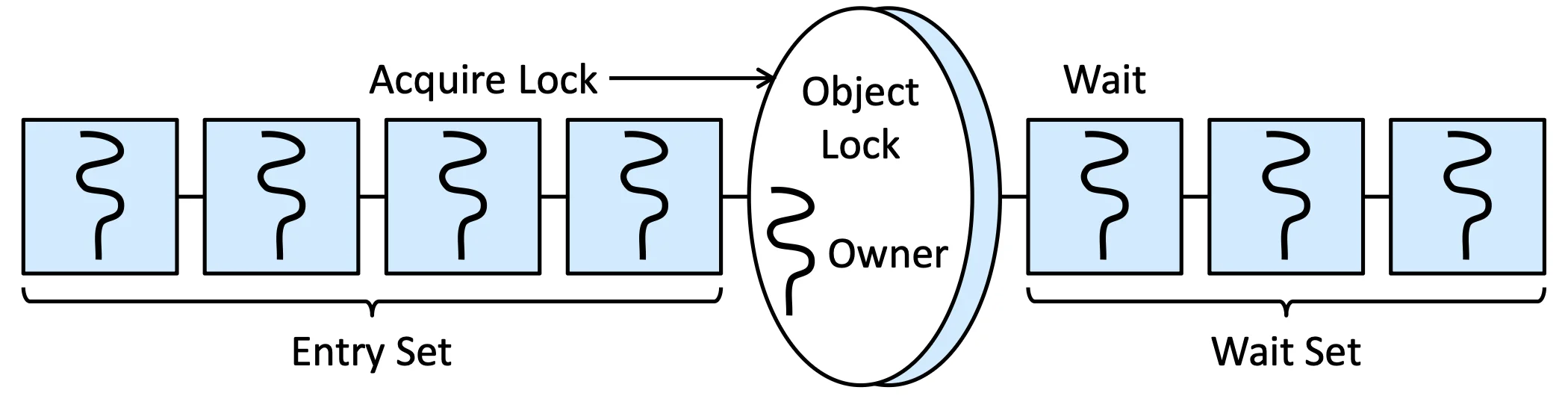
剛剛提到要進入的 entry set 等待 acquiring lock,但其實還有一些 thread 本來有這個 lock,中間需要等一些 I/O 或其他 thread 的結果,需要先放掉 lock,這時候他就會 call wait(),也就是讓 thread 進入到 obj 的 wait set 等待
Call wait() 後 lock 會先被 release,然後把 thread 的狀態設定成 blocked,要注意 entry set 跟 wait set 是不一樣的,因為去 wait() 的 thread 是去等其他條件了,我們會用 notify() 去叫醒他,但 notify() 的運作有點特殊,會先
- 從 wait set 裡面隨機選一個 thread
T - 把他從 wait set 裡面放到 entry set
- 把
T設定成 runnable
call
notify()不保證是哪個 thread 被叫醒,也不保證叫醒後可以直接跑
Java Monitors: Bounded-Buffer#
我們用 Bounded-Buffer 當例子:
buffer就是 Bounded-Buffer 本人inproducer 要放的位置outconsumer 要讀的位置count代表 buffer 裡有幾個 item
下面兩個 method 我們都宣告成 synchronized
public class BoundedBuffer<E> {
    private static final int BUFFER_SIZE = 5;
    private int count, in, out;
    private E[] buffer;
    public BoundedBuffer() {
        count = 0;
        in = 0;
        out = 0;
        buffer = (E[]) new Object[BUFFER_SIZE];
    }
    /* Producers call this method */
    public synchronized void insert(E item) {
        while (count == BUFFER_SIZE) {
            try {
                wait();
            }
            catch (InterruptedException ie) { }
        }
        buffer[in] = item;
        in = (in + 1) % BUFFER_SIZE;
        count++;
        notify();
    }
    /* Consumers call this method */
    public synchronized E remove() {
        E item;
        while (count == 0) {
            try {
                wait();
            }
            catch (InterruptedException ie) { }
        }
        item = buffer[out];
        out = (out + 1) % BUFFER_SIZE;
        count--;
        notify();
        return item;
    }
}
wait()是在 wait set 等而不是 entry set 等,因為你已經 call 了 method 表示 lock 已經拿到了才會開始執行,但因為某些原因你不能被執行(此處是 buffer 滿了)
Java Reentrant Locks#
Java 的 Reentrant Locks 用 ReentrantLock class 實現,用 lock() 去 call
如果 lock 已經被 own 了也沒關係,重複 call 不會造成 deadlock 或 race condition,詳見 SP 筆記
Lock key = new ReentrantLock();
key.lock();
try {
    /* critical section */
}
finally {
    key.unlock();
}finally 的作用是讓任何 exception 發生的時候,會直接 call 這裡面的 program 執行回收,也就是說,我們把 unlock() 放在這就可以防止 deadlock
Java Semaphores#
用以下方法做 construct
Semaphore(int value);先拿到 semaphore 後才能進入 critical section,finally 要確保 exception 發生的時候還是得要 release lock
Semaphore sem = new Semaphore(1);
try {
    sem.acquire();
    /* critical section */
}
catch (InterruptedException ie) {}
finally {
    sem.release();
}Java Condition Variables#
在 java 裡面要 create 一個 condition variable 可以
- Create 一個
ReentrantLock - 對那個
ReentrantLockcallnewCondition()method 產生他的對應Conditionobject
以下是用法
Lock key = ReentrantLock();
Condition condVar = key.newCondition();用 await(), signal() 來做使用
Alternative Approaches#
Transactional Memory#
memory transaction 也就是把一連串的 memory 全都包起來 atomically 執行,call atomic{S} 讓 S 這一連串的操作都能 atomically 執行
void update() {
    atomic {
        /* modify shared data */
    }
}OpenMP#
可以用 #pragma omp critical 來指定哪一段要成為 critical section,會 atomically 執行
void update(int value)
{
    #pragma omp critical
    {
        count += value
    }
}Functional Programming Languages#
可以把 variable 當成 immutable 的,也就是初始化設定後就不能變動了,會影響 performance,但最終希望解決 data race 的問題