Instruction Set Architecture: RISC-V#
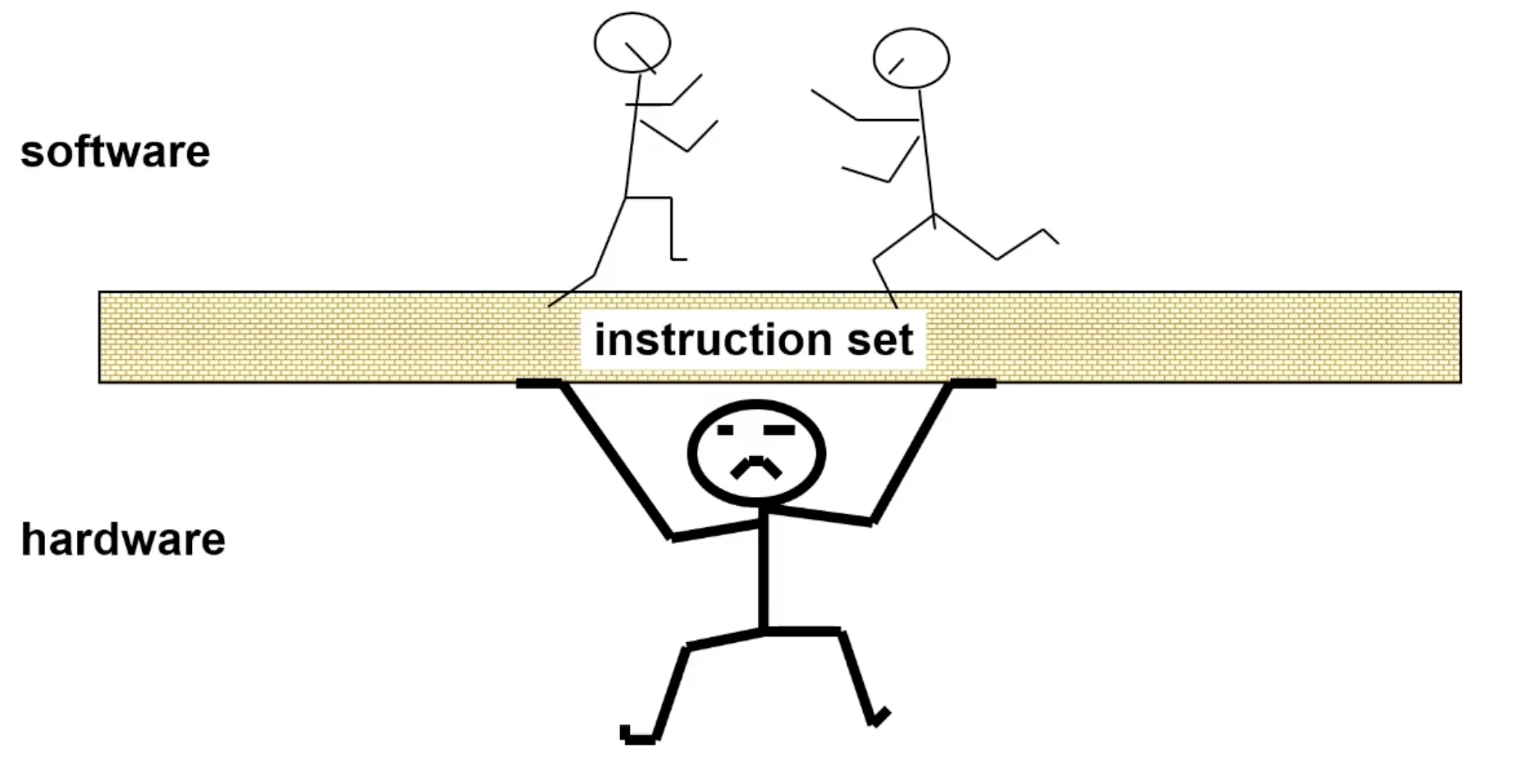
ISA (Instruction Set Architecture) 是一種硬體軟體之間的 interface,要可以連接軟硬體
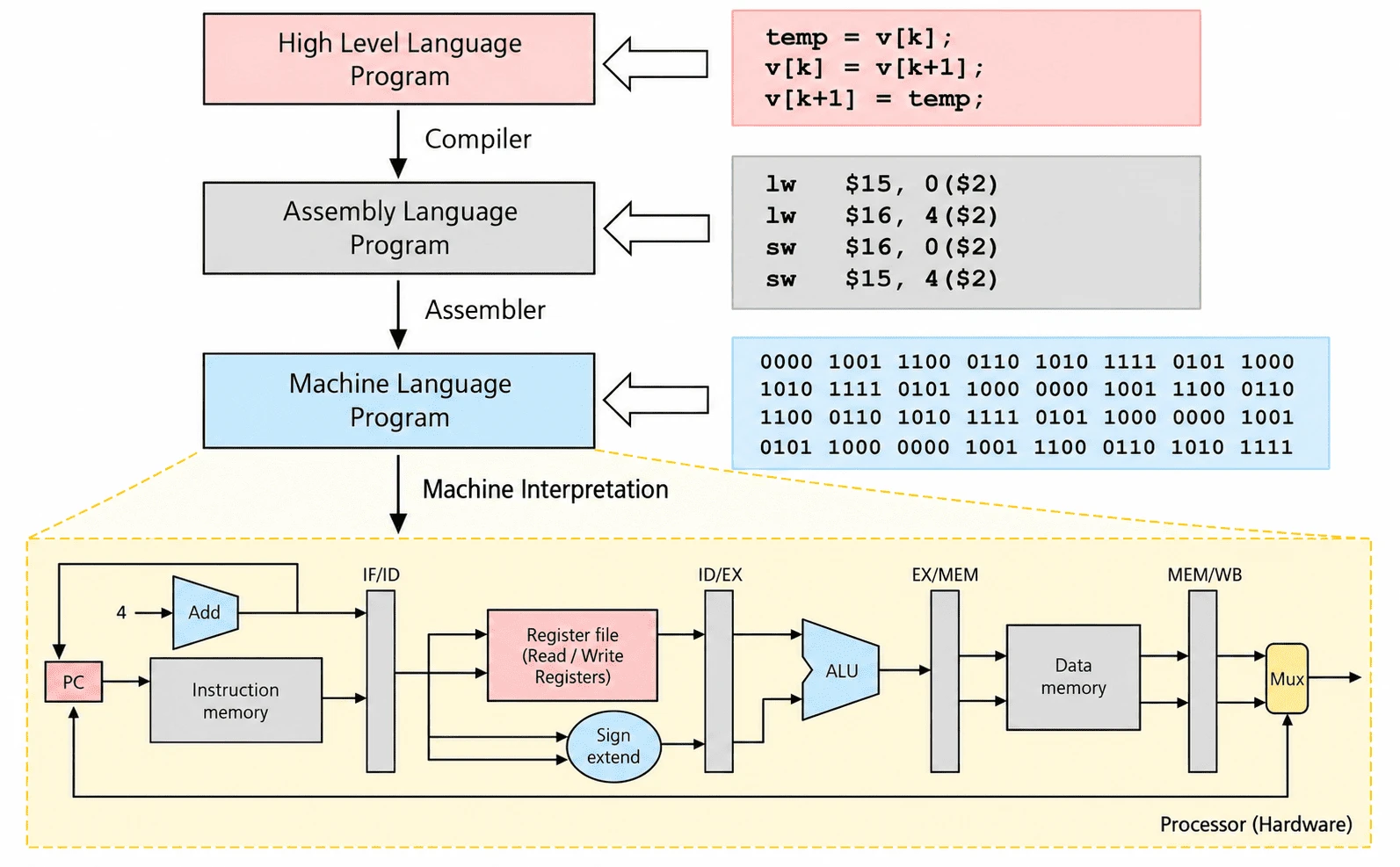
整個電腦的執行會先用 high level language 寫成,然後經過 Compiler 轉成 assembly language,最後透過 Assembler 轉換成 Machine Code,最後真正在 hardware 裡面的 data path 執行的就會是 Machine code
ISA design#
ISA 的設計要求就是我們希望要讓 underlying 的 architecture implement 起來要是簡單的,hardware 簡單就可以達到速度增快並且 Power 消耗減低
設計一個 interface 有幾個重點
- Portability/Compatibility:底下的 implementation 方法不應該要影響到 user 體驗
- Generality:要多種用途,不可以太單一
- Convenient:對於使用者而言方便 call
- Efficient:Implementation 要快速
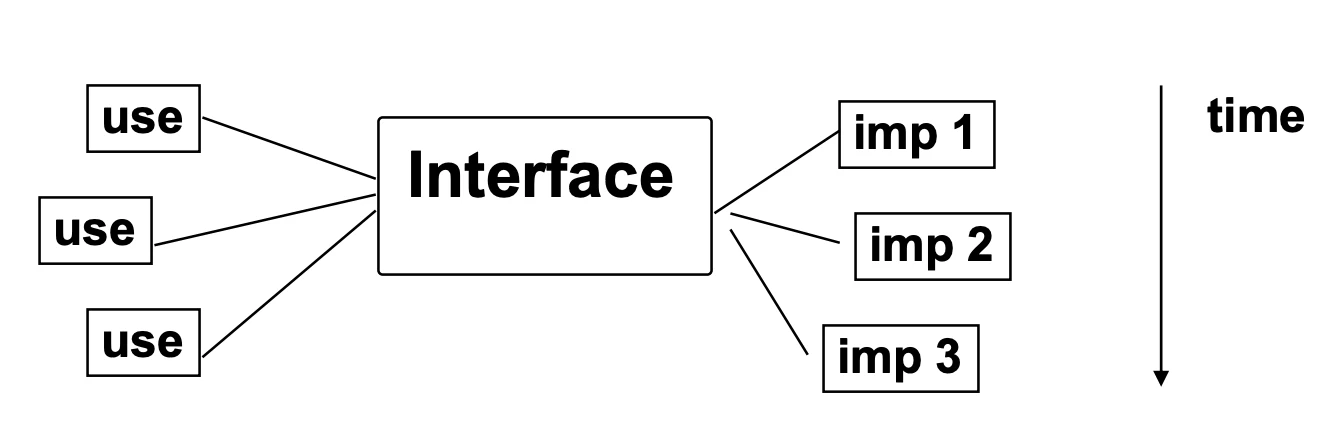
而對於 ISA 的上層,就是 Compiler,下層則是 data path,這通常是一個 trade-off 需要進行取捨
ISA flow#
以下是 ISA 的執行流程
- 把 Instruction fetch 到 register 裡面(本來在 memory)
- 把 Instruction 做 Decoding
- 把 Operand fetch 出來(不同的 machine 會存在不同地方)
- Execution
- 把結果 store 到正確的位置
- Fetch 下一個 Instruction
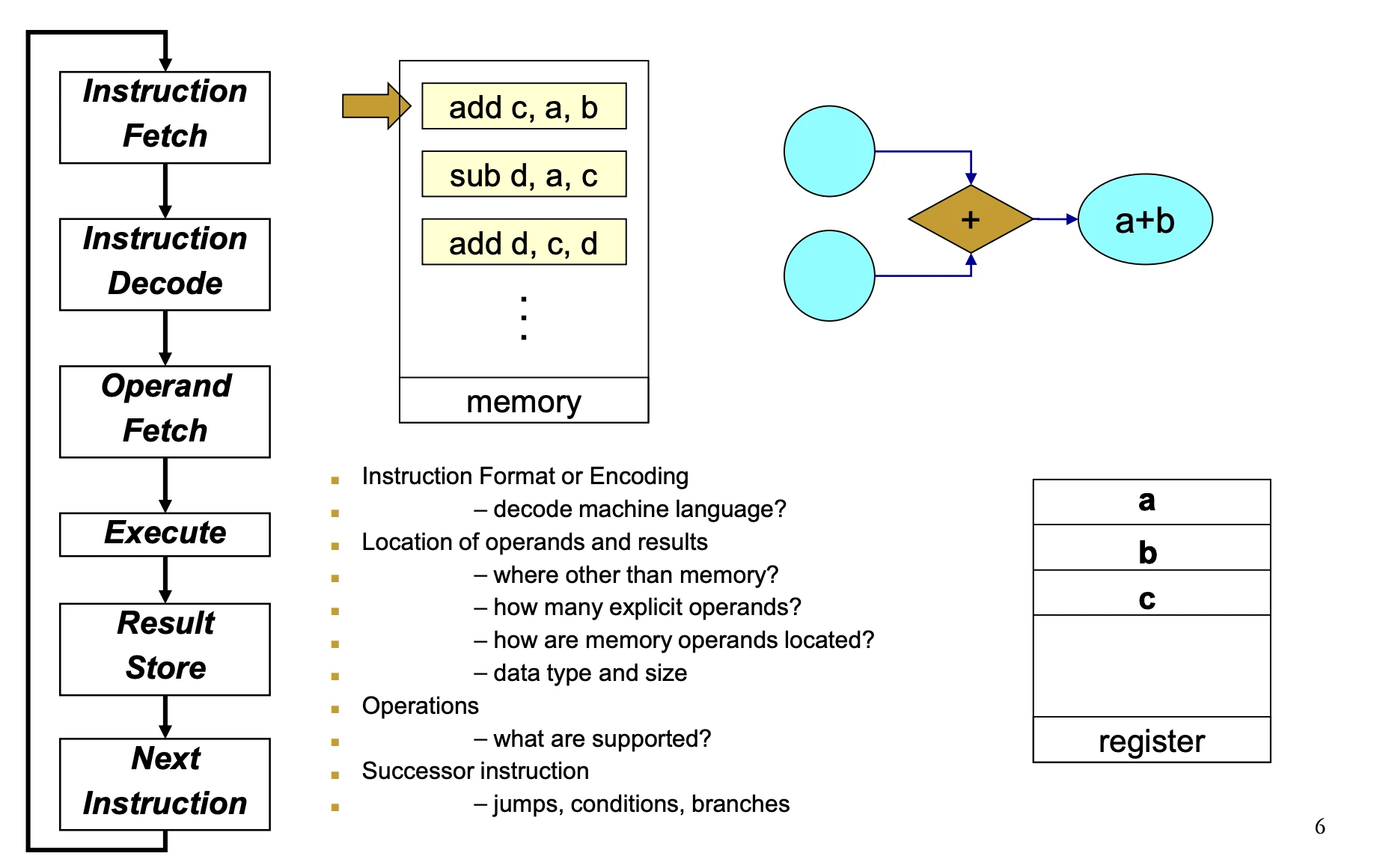
透過剛剛的流程我們知道我們設計一個 ISA 需要以下的東西
- Instruction Format (Encode/Decode)
- Location of Operands and Result
- Size and Type
- Operations to support
- Successor instruction
- jumps, conditions, branch
General Purpose Register ISA#
General Purpose Register ISA 是一個 design 的大類別(其他可能像 java 用的是 stack 不是 register),這種方法有兩種設計
- Register-memory instruction 也就是其中個 operand 來自 memory 另一個來自 register
add R1, A             # R1 = R1 + mem[A]
add R2, R1, A # R2 = R1 + mem[A]- Register-register instruction 是其中兩個 operand 來自都在 register,會多了
load,store
add R2, R1, R3        # R2 = R1 + R3
load R3, A            # R3 = mem[A]
store R3, A # mem[A] = R3這就是為什麼我們不能用 MPIS 來 evaluate 兩個 machine,因為每個 ISA 完成同一個操作的 Instruction 數量不同
RISC v.s. CISC#
以前分成了兩個陣營
- RISC (Reduced Instruction Set Architecture):儘量讓所有 Instruction 越簡單越好,雖然同個操作的 instruction 數量比較高,但 Clock Rate 會提高,e.g. ARM, RISC-V, MIPS
- CISC (Complex Instruction Set Architecture):這個派別追求越少 Instruction 越好,執行一個操作只需要極少的操作,也就是說 Compiler 會獲得 high-level language 的一對一對應,很好做,但 Clock rate 無法提高(因為 Underlying 的 implementation 比較複雜),e.g. Intel x86
RISC-V#
是一個 standard open source 的 ISA,其他的 ISA 的 license fee 都很高(MIPS, ARM)
- 軟體有 Linux 所以當初也想要仿照做 RISC-V,也就是一個開源的 ISA 架構
- 也有像 SiFive 這樣提供 RISC-V 一系列 tool chain 的公司
- 中國會使用這樣的 open source 的 ISA
到後期,Intel 也轉往 RISC 發展
Operation on RISC-V#
Arithmetic Operations and Register file#
arithmetic operation 包含 +, - *, /,要求必須有三個 operand,三個都是 register
add a, b, c;第一個是 destination,其他兩個是 source,從這個操作就可以知道 RISC-V 的一項設計原則 Simplicity favors regularity
- Regularity:所有 operation 都需要 take 3 個 operands(固定數量),並且只允許在 register 之間操作(固定位置),這樣就可以得到 Simplicity of Hardware design
假設我們有一個 c statement
f = (g + h) - (i + j)翻譯後會變成
add t0, g, h;
add t1, l, j;
sub f, t0, t1;但這些變數我們該存在哪,我們應該要把這個結果存在 register 裡面,RISC-V 的 register file 一共有
這個數量,在這裡我們稱每個 Register 為一個 file
- 64-bits data 叫 “double word”
- 32-bits data 叫 “word”
這裡看引出第二個設計原則 Smaller is faster
- Register file 需要在 capacity 跟 efficient 之間做取捨,而 RISC-V 選擇了 efficient
以下是 RISC-V register 對應 function 存儲的內容,之後會細講
x0              the constant value 0
x1              return address
x2              stack pointer
x3              global pointer
x4              thread pointer
x5-x7, x28-x31  temporaries
x8              frame pointer
x9, x18-x27     saved registers
x10-x11         function arguments/results
x12-x17 function arguments我們知道這些 register 的功能後,我們就可以重新把 assembly 寫成 RISC-V
add x5, x20, x21
add x6, x22, x23
sub x19, x5, x6Memory Operation#
有兩種 Data transfer instructions lw, sw, ld, sd
lw x9, 8 (x22); # x9 = mem[8 + reg[22]]
sw x9, 8 (x22); # mem[8 + reg[22]] = x9也就是 load 跟 store,後面的字母代表 word, byte,但我們需要理解他的 address 是怎麼 binding 的,基本上我們會把寫在這 register 叫做 base register,後面加上一個 offset,我們就知道要把誰 load 或是 store 進來
假設我們有一段 C code
A[12] = h + A[8]假設 h 在 x1,我們的 base register A 是 x22,那我們的 assembly 應該要翻譯成
ld x9, offset1(x22);
add x9, x21, x9;
sd x9, offset2(x22);但這裡的 offset 應該要怎麼算的,首先我們知道每個 element 是 8 bytes,用 index 來看,A[8] 對 x22 的 offset 應該是 8,但是 RISC-V 是一個 byte addressing,所以
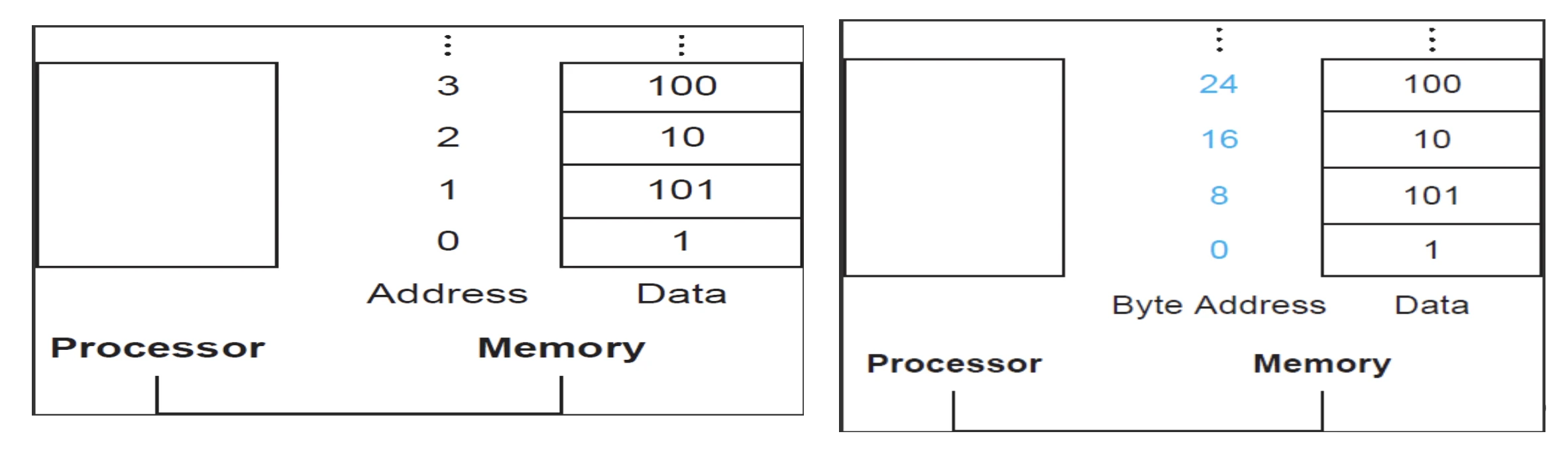
所以正確的翻譯方法應該是
ld x9, 64(x22);
add x9, x21, x9;
sd x9, 96(x22);Endian#
假設我們有一個 16 進位的數字要存進去一個 8 bytes 的 register,每個 address(一個 byte)可以存兩個 16 進位的數字,一個 hex digit 的大小是 4-bit 兩個就是 1 byte,當我們有一個數字 0x12345678 想存到 register 裡面的時候,我們可以選擇兩種方法
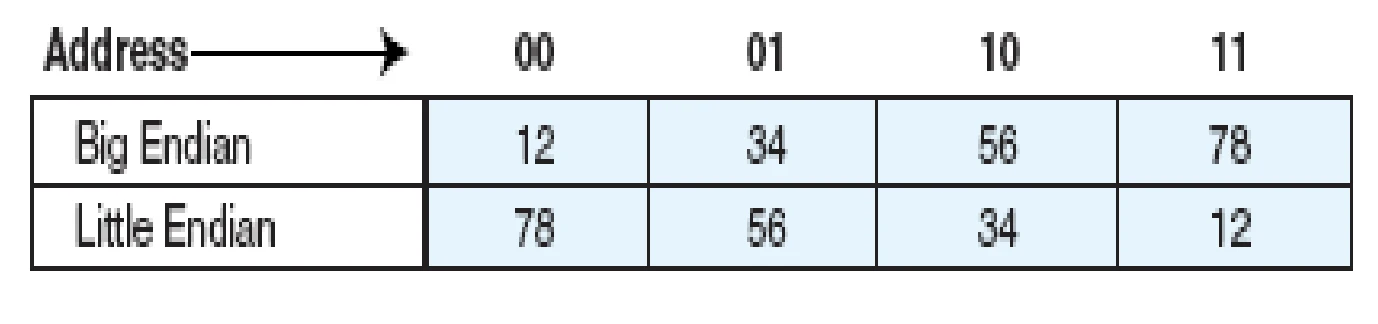
- Big Endian 是先把高位數字存到 address 小的 register
- Little Endian 是先把低位數字存到 address 小的 register
RISC-V 是一種 Little Endian
Alignment#
每次 register 都是讀一個或兩個 word 也就是 4 bytes,Alignment,這件事就代表我們必須讓所有 data 都對齊 4 bytes 這個大小,也就是我們可以做一些空位子,來保證一個 openrand 儘量在同一個 word 裡面,這樣可以大大增加 ISA 的 memory operation efficiency
RISC-V 並沒有要求做這件事
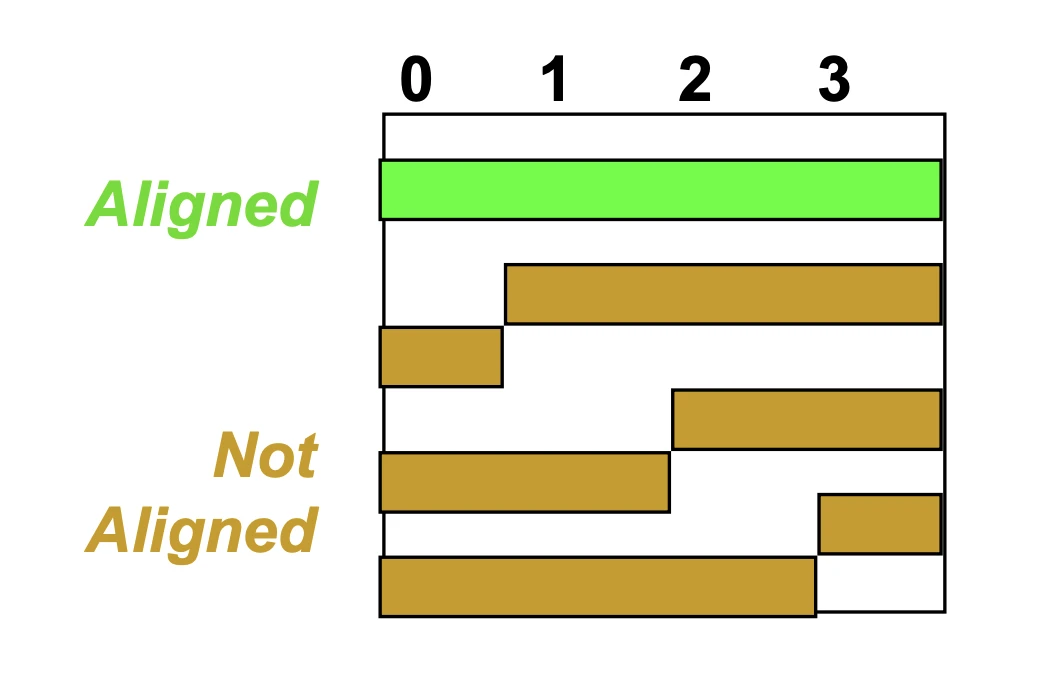
ISA 設計有一個宗旨,Load/Store 的次數要越少越好,通常這是 compiler optimization 的工作,但是 register size 的大小會大大影響到我們的做 compiler optimization 的難度
另外,因為 Compiler 應該要用 Register 作為儲存 variable 的空間,但 register 用完的時候我們肯定得把某些不常用的 variable 存回去 memory 裡面,這個動作叫做 memory spill,減少 memory spill 也是 compiler optimization 重要的 issue
Intermediate Operation#
在 high-level language 裡面我們常常會用到 constant arithmetic,比如說
x = x + 10那我們可以用 load, store 做到這件事
ld x21, AddrConst10(x22)
add x22, x22, x21就可以做到,但這樣的操作很頻繁出現我們需要加快這一部分,因此 RISC-V 設計出了
addi x22, x22, 4這樣就引出了 RISC-V 的第三個設計原則 Make the common case fast,不會太增加 implementation 的複雜度,但是會卻可以減少 compiler 的 optimization 難度
Representing Instruction#
畢竟 machine 真正在執行的時候都是用 binary code,所以我們需要 define 出一種 format 來表示我們的 machine code
Stored-Program Concept#
先介紹一個非常重要的觀念,我們該如何儲存一個 program,分成兩個 key point
- Instruction represented as a number
- 整個 program 要可以存在一個 memory 裡面,並且可以像數字一樣讀寫
在 RISC-V 實踐的 machine 中都是用 Hexadecimal 來表示 instruction,因為這樣做 binary code 轉換非常方便
RISC-V R-format#

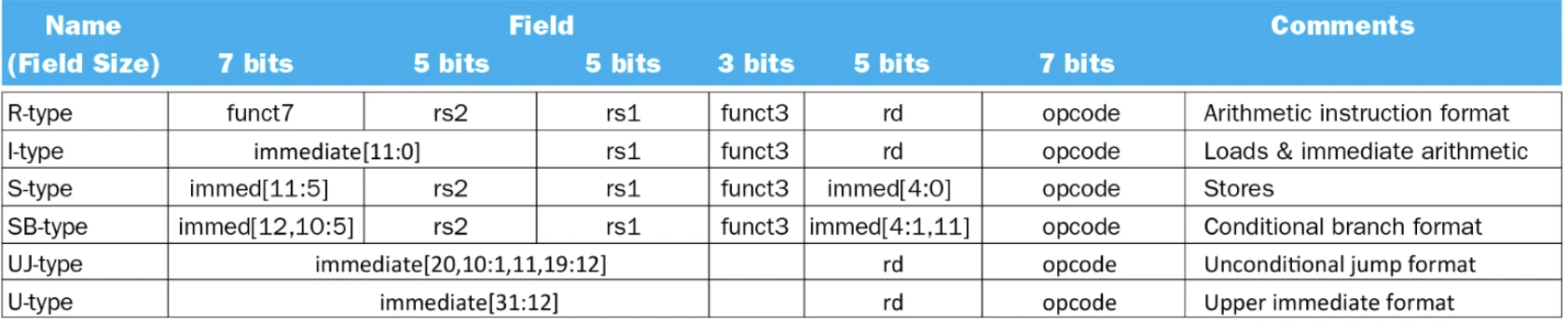
R-format 有以下的內容
opcode:operation coderd:destination register numberfunct3:3-bit function code (additional opcode)rs1:the first source register numberrs2:the second source register numberfunct7:7-bit function code (additional opcode)
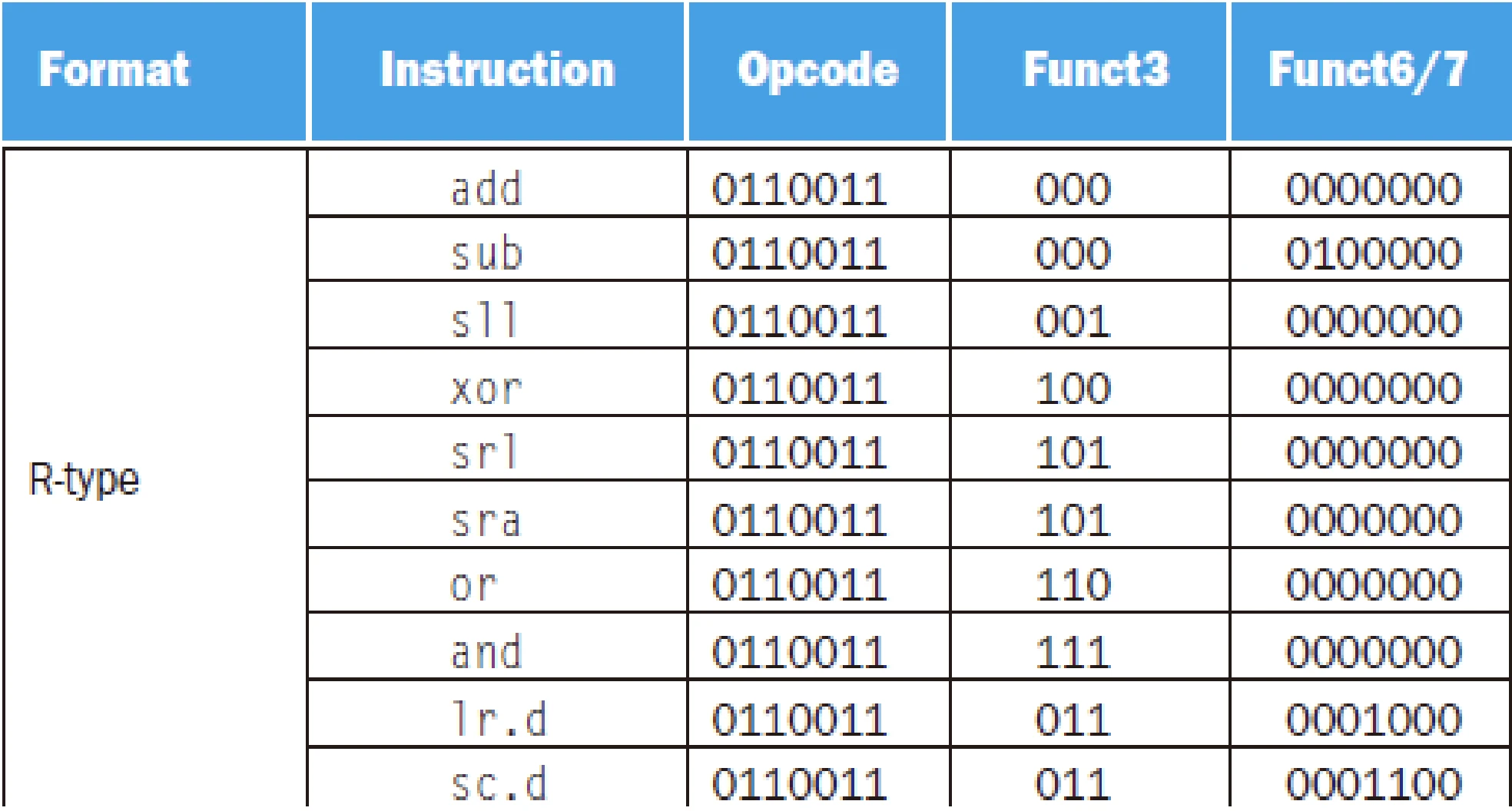
假設我們有一個指令是
add x9, x20, x21;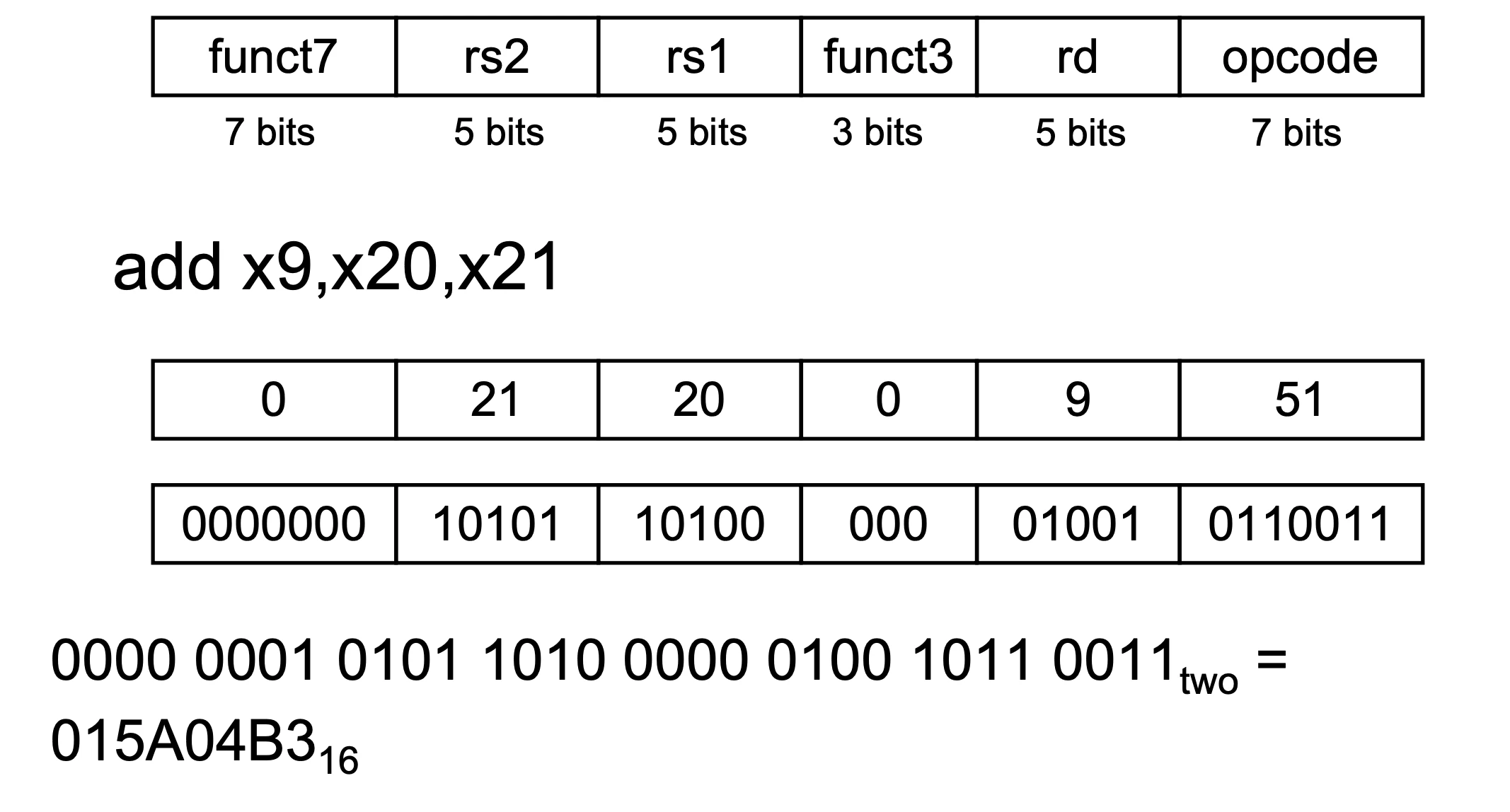
RISC-V I-format#
我們現在來考慮一下 load operation,在 R-format 之下,我們有 rs1, rs2, rd 三種可用的 field,我們會有三個 5-bits 的 field 可以用,但其中有一個位置應該要填 offset 這個資訊,但 5-bit 最多只能表示到 32 格 offset,所以我們應該要開發另外一種 format 來表示這樣的操作

immediate:register numberrs1:the first source register numberfunct3:3-bit function code (additional opcode)rd:destination register numberopcode:operation code
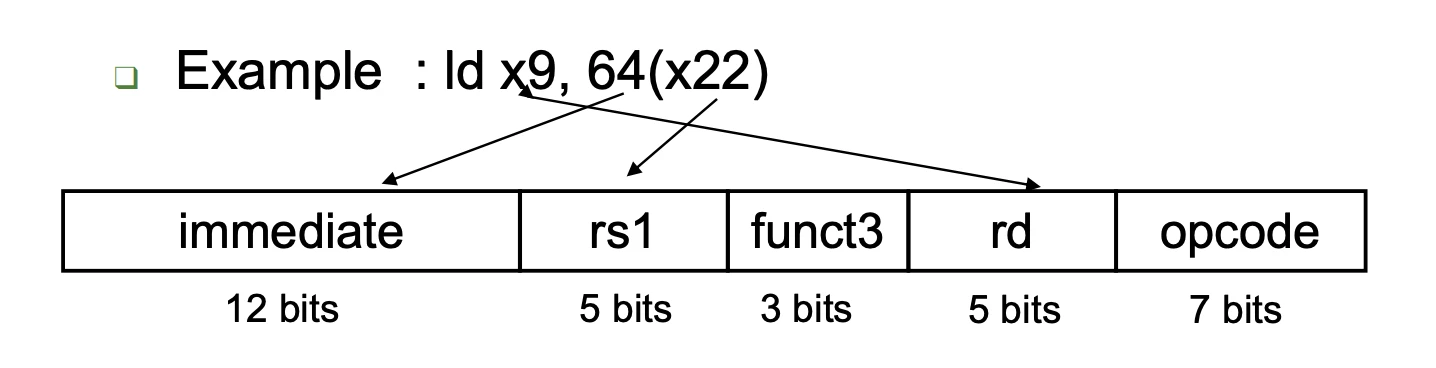
由此我們就可以引出第四個設計原則:Good Design demands Good compromise,雖然我們前面有說設計必須要符合 Regularity 但為了 regularity 會犧牲掉太多 efficiency 這樣反而得不償失,所以有時候我們還是得做出一些 compromise
這個
immediate也可以是負數,只需要我們使用 2’s complement
RISC-V S-format#

這是一種為了 store operation 而特化的 format,因為他沒有 destination register,但有兩個 source register,為了 decode pipeline, datapath 的設計,我們不希望同樣 representation 的 field 在不同 format 裡面被放在不同地方,所以我們可以看到 immediate 被分成了兩個部分,並且用 little endian 去做 encode
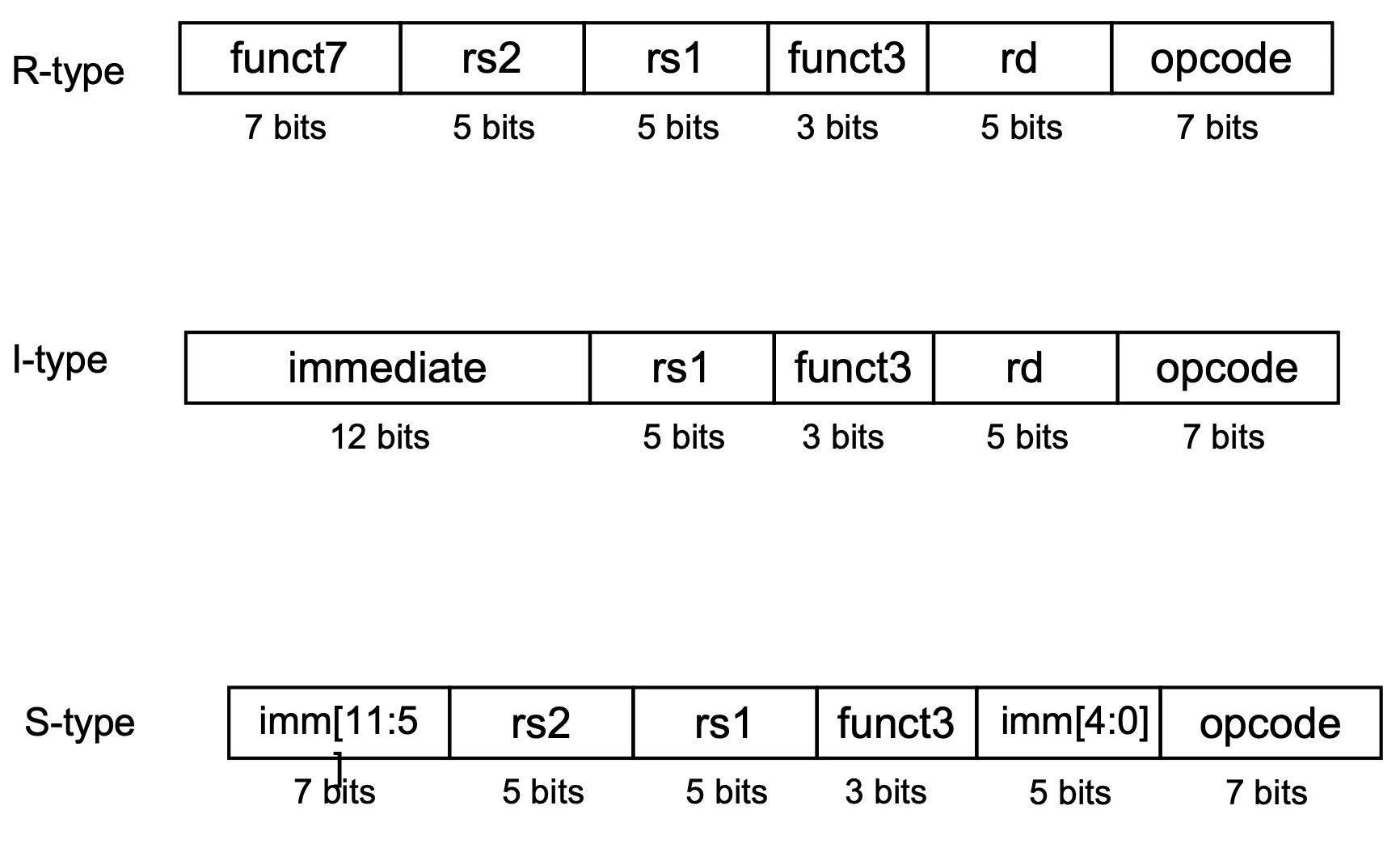
如果我們把三種 format 放在一起來看,可以明顯地看到他是完全基本上同樣的功能都是對齊的
Logic Operation#
| Operation | C | RISC-V |
|---|---|---|
| Shift left | << | slli |
| Shift right | >> | srli |
| Bit-by-bit AND | & | and, andi |
| Bit-by-bit OR | | | or, ori |
| Bit-by-bit XOR | ^ | xor, xori |
| Bit-by-bit NOT | ~ | not |
Shift Operation#

因為 Shift Operation 最多只需要 6-bits 作為 shift constant,所以我們可以把 I-format 前面 6-bits 改回 其他 function code 輔助 opcode,specify 是哪種 operation
如果有些 multiply 或是 division 的步驟是要做 的話,就可以直接用這個 instruction,速度比較快
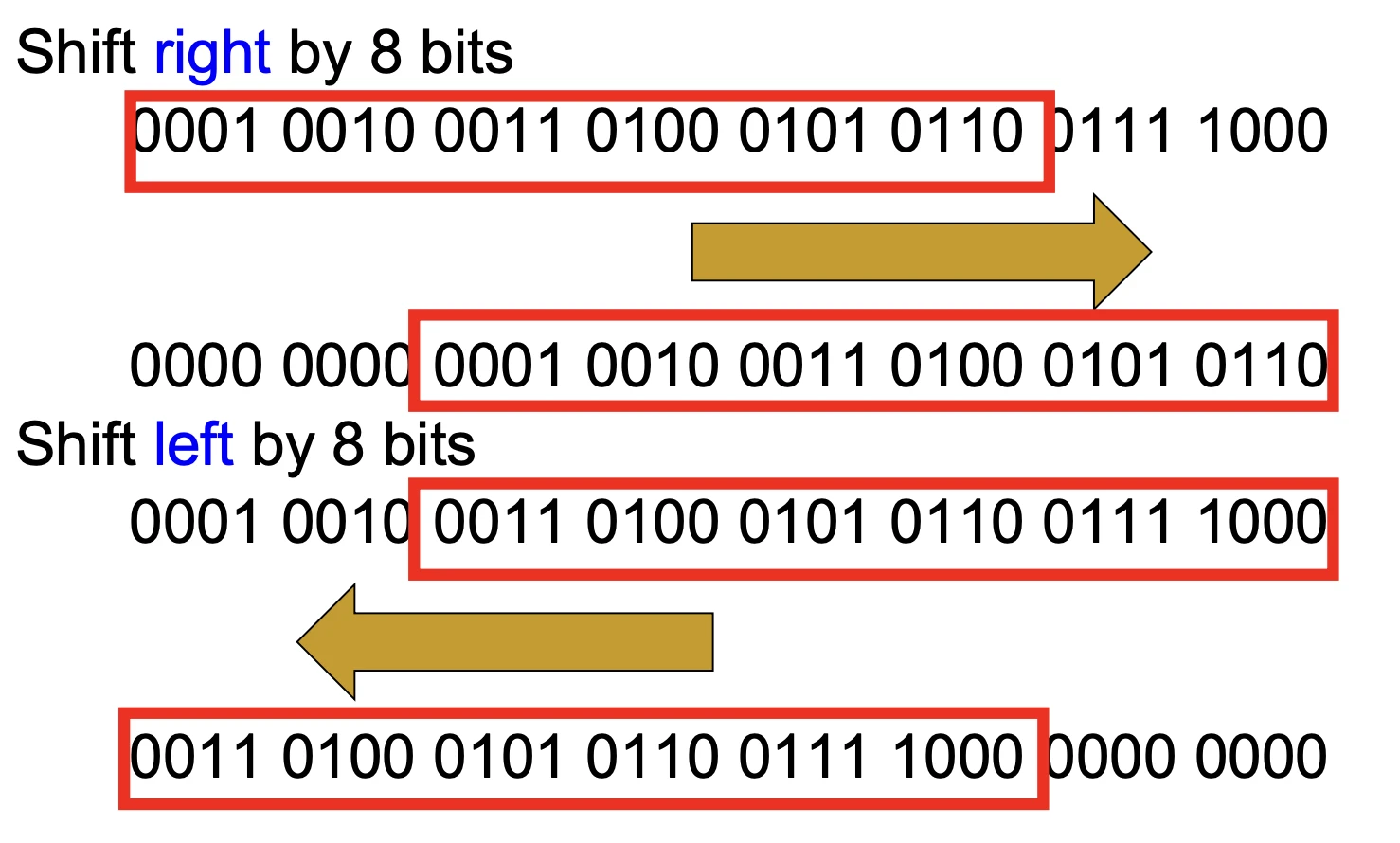
使用方法本質上就是 I-format 加上固定的 imm[5:11](作為 funct6)而已
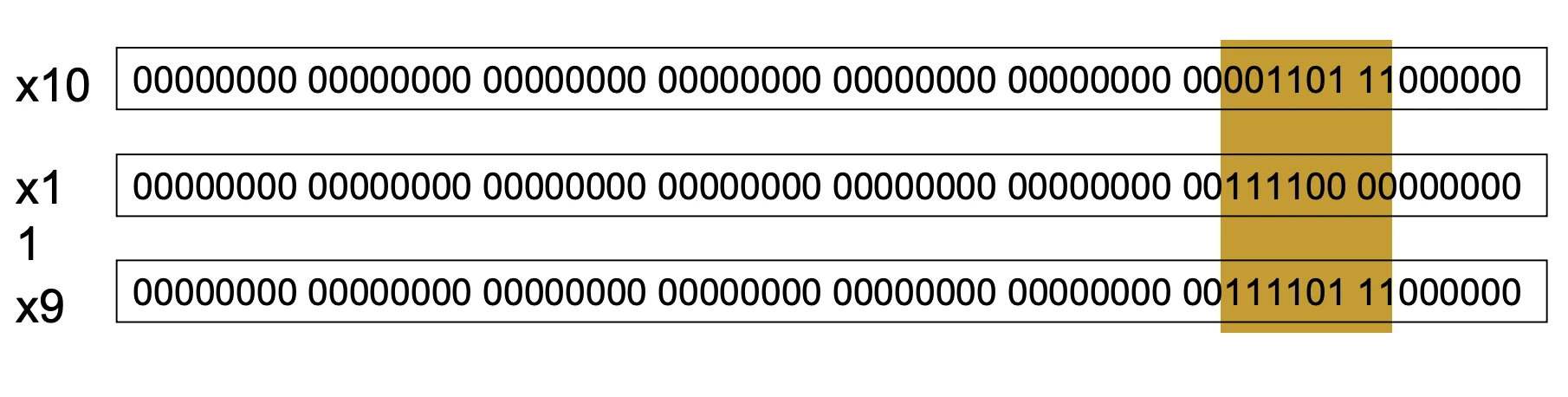
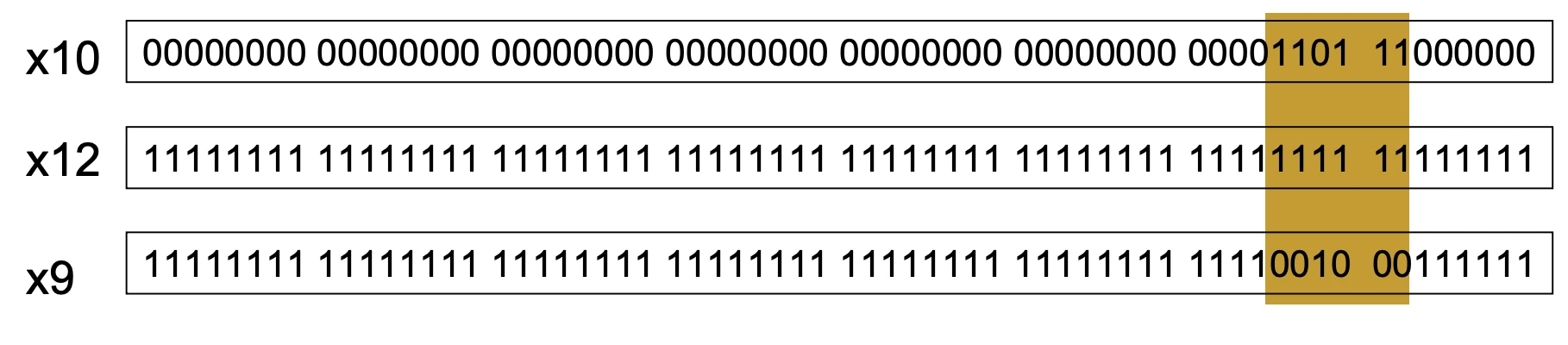
AND, OR, XOR operation#
這三個 operation 本質上用法都一樣
and x9, x10, x11;
or x9, x10, x11;
xor x9, x10, x11;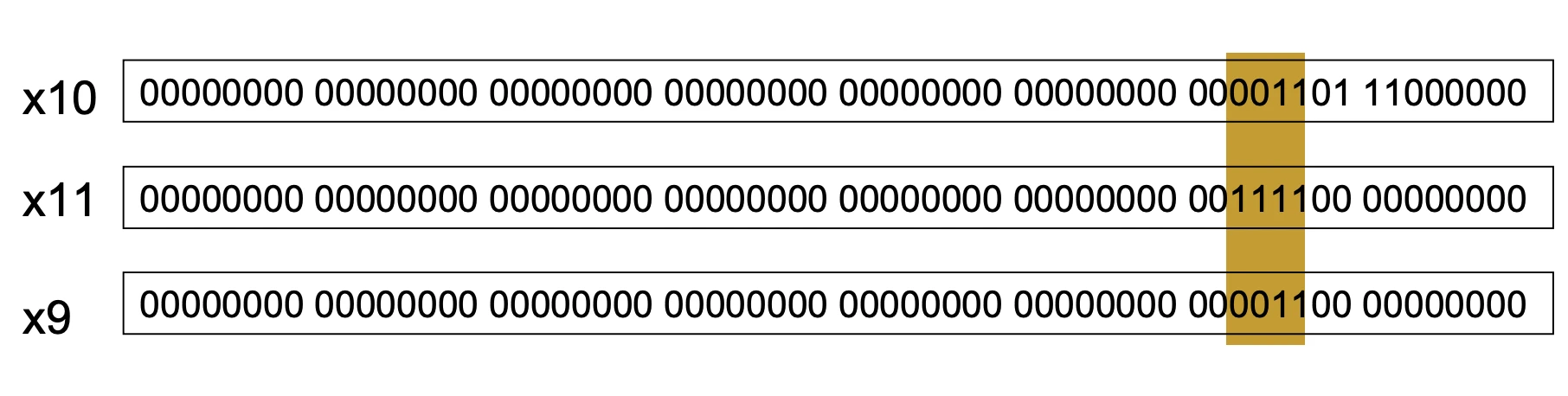
Instruction for Decision Making#
一個 program 真的在執行的時候,我們必須要知道現在到底要執行哪行指令,所以我們需要一個類似 pointer 的東西來指向我們目前執行到哪裡,這個東西叫做 Program Counter (PC),也就是現在要執行的,因此當我們要做 branch operation,也就是任何 改變 Control flow 的 Operation,都是用操作 PC 的方式
執行的指令可以用這個簡化版 instruction 表示
mem[PC]如果在沒有 decision 的 control flow 下,下一個是做
mem[PC + sizeof(instruction)]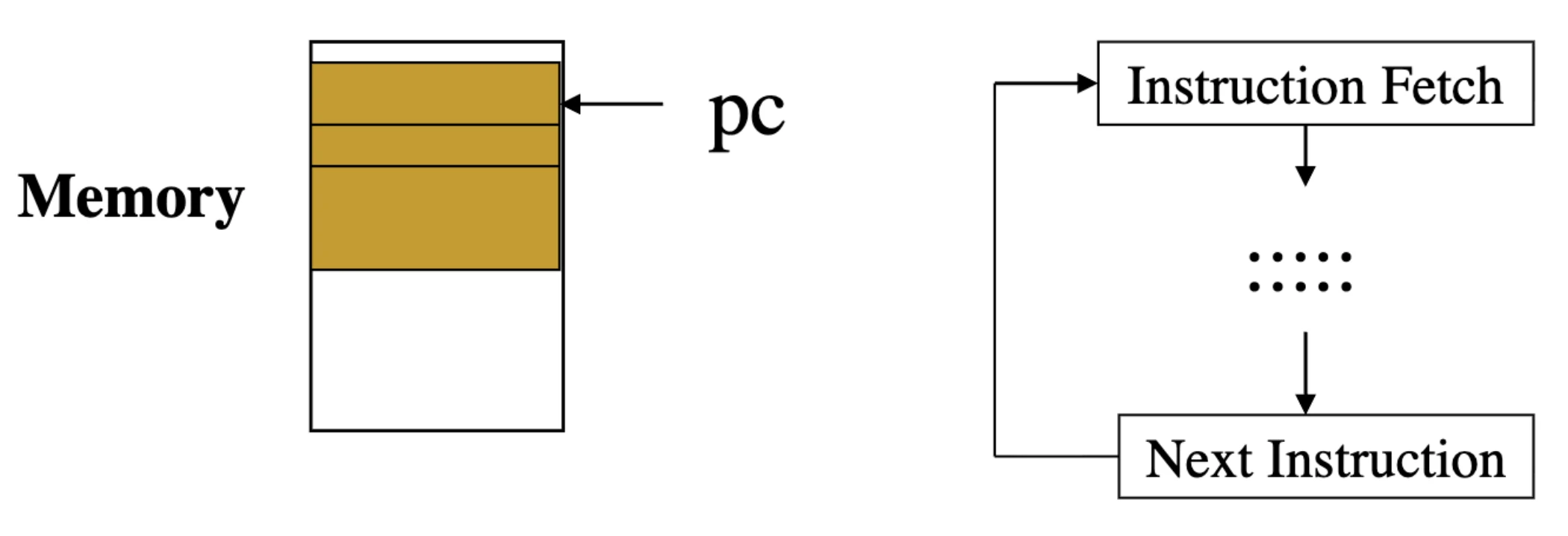
Conditional Operation#
分成兩種分別是等於以及不等於後該做什麼操作
-
Equal Branch
riscvbeq rs1, rs2, L1轉換成 high-level language 就是
cif (rs1 == rs2) { branch to instruction labeled L1 } -
Unequal Branch
riscvbne rs1, rs2, L1則是
cif (rs1 != rs2) { branch to instruction labeled L1 }
if-else statement#
這裡有個例子,如果想要完成
if (i == j) {
    f = g + h
} else {
    f = g - h
}我們把它 Compile 成 RISC-V language,我們給出一些假設
f,g,hstore 在x19,x20,x21i,jstore 在x22,x23
  bne x23, x24, Else;
  add x19, x20, x21;
  beq x0, x0, Exit;
Else:
  sub x19, x20, x21;
Exit:
...執行流程大約像這樣
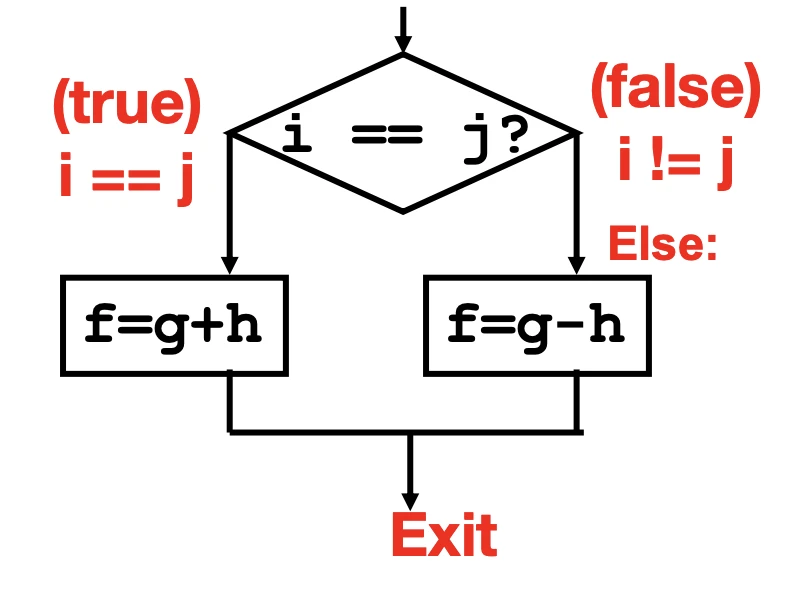
我們可以看到,我們是用 label 作為 branch 的起始點,asssembler 的其中一個工作,就是把那個 label 替換成實際的 address
while statement#
while (state[i] == k) {
    i += 1;
}假設
istore 在x22kstore 在x24savesotre 在x25- 每個 element 都是 8-bytes
Loop:
  slli x10, x22, 3;
  add  x10, x10, x25;
  ld   x9, 0(x10);
  bne  x9, x24, Exit;
  addi x22, x22, 1;
  bne  x0, x0, Loop;
Exit:
...前三行的 code,我們先把 x22 也就是 i 乘以 8(bytes) 存在某個 register 裡面,然後把 save 裡面的那個 element 跟 k 也就是 x24 做比較,最後跳回 Loop label 上
Basic Block#
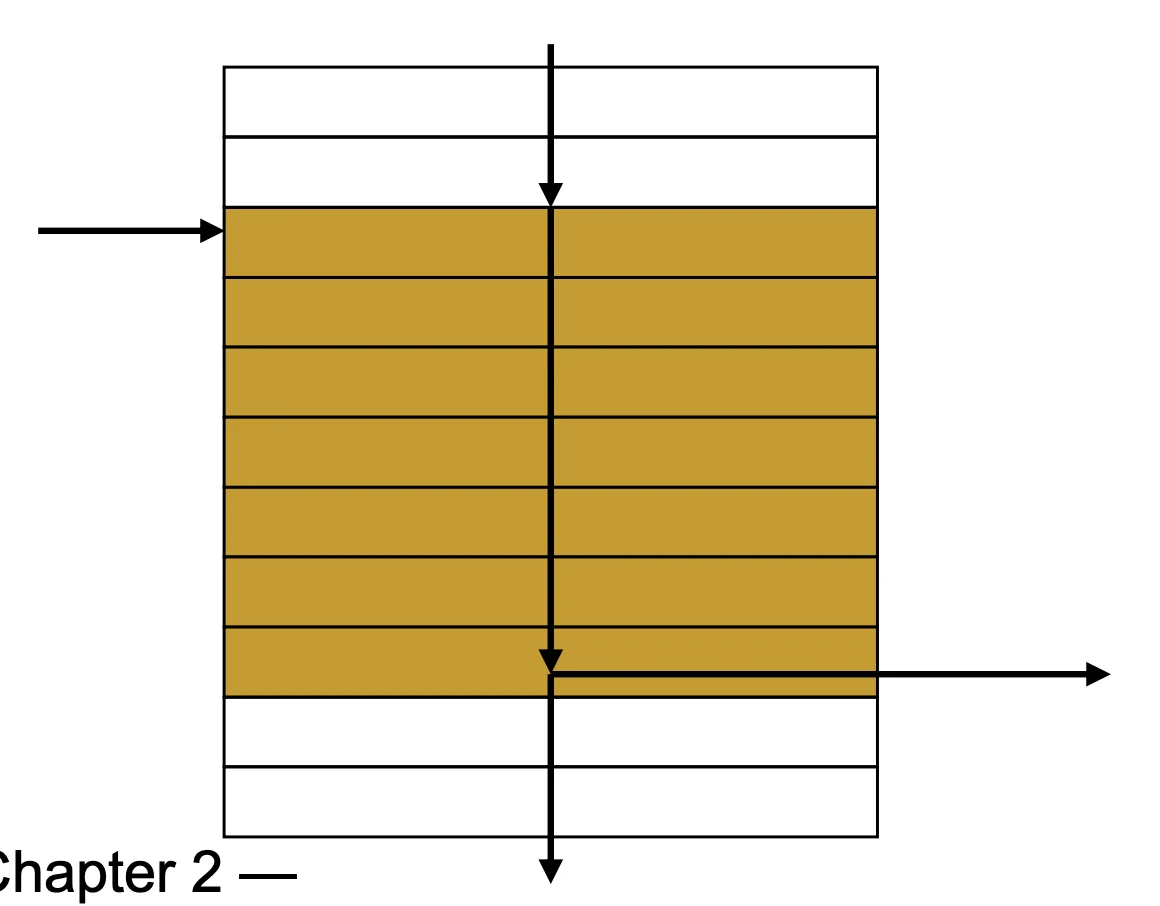
在 assembly 中,一個 basic block 的需要符合兩個條件
- Block 裡面沒有 embedding branch(不會跳出去)
- Block 裡面沒有 branch target(不會從中間開始執行)
也就是說這一段 code 的執行一定是一起的,我們需要知道這件事是因為我們需要做 compiler optimization,如果一段 program 會怎麼被執行要跑了才知道,但是如果我們有了 basic block 的概念,我們就可以把這個 block 裡面的 code 做 reordering 而不會影響其他 code
More Conditional Operation#
RISC-V 還支援了
blt rs1, rs2, L1;
bge rs1, rs2, L2;分別代表的是
if (rs1 < rs2) {
    branch to L1
}if (rs1 >= rs2) {
branch to L1
}還有
slt reg1, reg2, reg3;是 set less than 的縮寫,意思是
if (reg2 < reg3) reg1 = 1;
else reg1 = 0;Signed and Unsigned#
一個數字是 signed 還是 unsigned 會大大影響到這個指令 conditional operation 怎麼執行
x22 = 1111 1111 1111 1111 1111 1111 1111 1111
x23 = 0000 0000 0000 0000 0000 0000 0000 0001這兩個數字如果要比較的話(signed number 會用 2’s complement 做負數轉換)
- Signed: -1 < +1
- Unsigned: 429496295 > 1
switch statement#
switch (k) {
    case 0: f = i + j; break;
    case 1: f = g + h; break;
    case 2: f = g - h; break;
    case 3: f = i - j; break;
}假設
kstore 在x18fstore 在x19gstore 在x20hstore 在x21istore 在x22jstore 在x23x5,x6,x7是 temporary registerx28用來存JumpTable的起始 address
.data
JumpTable: .word L0, L1, L2, L3

.text
    slt  x5, x18, x0        # Test if k < 0
    bne  x5, x0, Exit       # if k < 0, go to Exit

    slti x5, x18, 4         # Test if k < 4
    beq  x5, x0, Exit       # if k >= 4, go to Exit

    la   x28, JumpTable     # x28 = address of JumpTable[0]
    slli x5, x18, 2         # x5 = k * 4
    add  x6, x5, x28        # x6 = address of JumpTable[k]
    lw   x7, 0(x6)          # x7 = JumpTable[k]
    jr   x7                 # jump to the address stored in x7

L0:
    add x19, x22, x23
    j Exit

L1:
    add x19, x20, x21
    j Exit

L2:
    sub x19, x20, x21
    j Exit

L3:
    sub x19, x22, x23

Exit:
...前四行的 code 先檢查 k 是否在合法範圍 0 <= k < 4。如果 k < 0 或 k >= 4,就直接跳到 Exit。
接下來先用 la 把 Jump Table 的起始 address 存進 x28。因為 Jump Table 中每個 entry 是一個 .word,也就是 4 bytes,所以用
slli x5, x18, 2把 k 左移 2 bits,也就是算出 k * 4。接著把這個 offset 加到 JumpTable 的起始 address
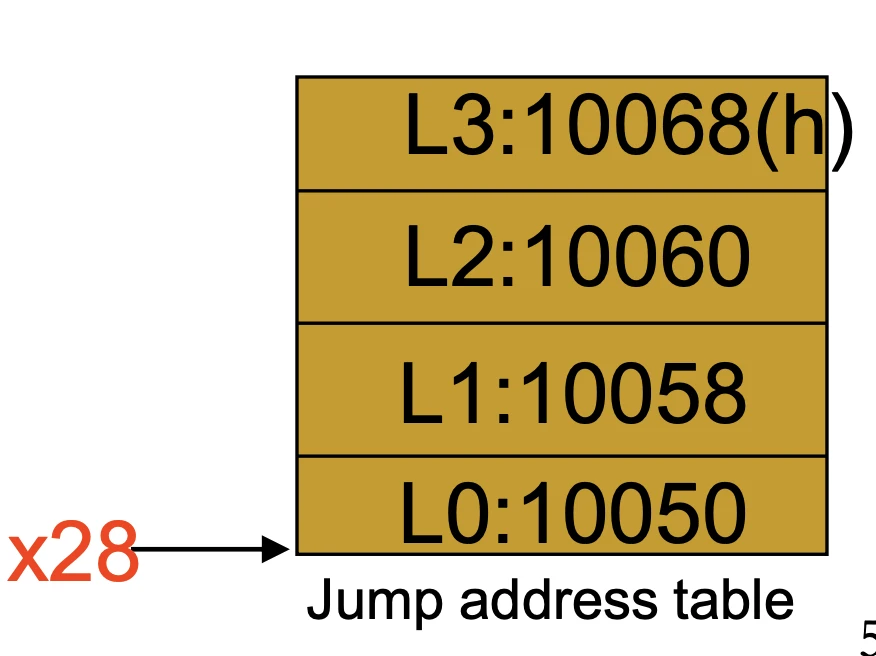
再用 lw 把 JumpTable[k] 裡面存的 label address 讀到 x7,最後:
jr x7直接跳到對應的 L0、L1、L2 或 L3,而每個 case 後面的 j Exit 就是在實作 C 裡面的 break。
.text是放執行 code 的部分,.data是放任何 data structure 宣告的 section
Pseudo Instruction#
我們可以看到
la x28, JumpTable這行指令,這並不是原始 RISC-V 就有定義的 Instruction,而且組合了好多個 Instruction 為了方便 Programmer 寫 assembly 才弄出來的東西,Assembler 會先把他們轉換成真正有 define 的 RISC-V Instruction
jr x7也是一個 pseudo instruction,就是 Jump 到 register x7 的位置就對了
Procedure Call Instruction#
Procedure Call 在 high-level language 裡面很簡單,像是以下這個例子,我們用混合型的 code 寫一下
f1()是被f2()呼叫的所以叫 calleef2()是呼叫f1()的所以叫 caller
int f1 (int i, int j, int k, int g) {
    // ...
    add x9, x7, x8;
    return 1;
}

int f2 (int s1, int s2) {
    // ...
    add x9, x10, x11;
    i = f1(3, 4, 5, 6);
    add x7, x8, x9; // <- PC
    // ...
}一個 procedure call 大致可以分成以下幾個步驟:
- 把 parameters 放進 register,前 8 個 parameter 會放在
x10~x17- 有一種約定俗成的 calling convention,也就是 parameter 應該存在哪
- 把 control transfer 到 procedure 裡面
- 替 procedure 分配需要的 storage
- 如果 procedure 需要額外空間,就從 stack 上 allocate
- 執行 procedure 裡面的 operations
- 把 return value 放進 register
ret放在x10/x11,讓 caller 可以取得結果
- Return 到原本呼叫的位置
- return address 會存在
x1,procedure 執行完後,根據x1跳回 caller 繼續執行
- return address 會存在
Procedure call 要特別注意 register 的 save and restore,以上面這個例子來說 x9 有被 callee 用到,但我們後面 expect 他不應該是被操作過的,所以要有 restore 的動作
Procedure Call Operation#
在 Procedure Call 的時候,會需要 jump, link
jal x1, ProcedureLabel;這個操作會做兩件事
- 把
PCset 到ProcedureLabel上(jump) - 把現在 instruction 的 address 紀錄到
x1上(link)
而 Procedure Return,則會需要 jump to link register
jalr x0, 0(x1);意思就是跳到 x0 + x1 這個 address,也就是把 PC 設定回 x1,這個 x0 因為永遠都是 0,我們為了符合一樣的 instruction format 才這樣設計
Stack#
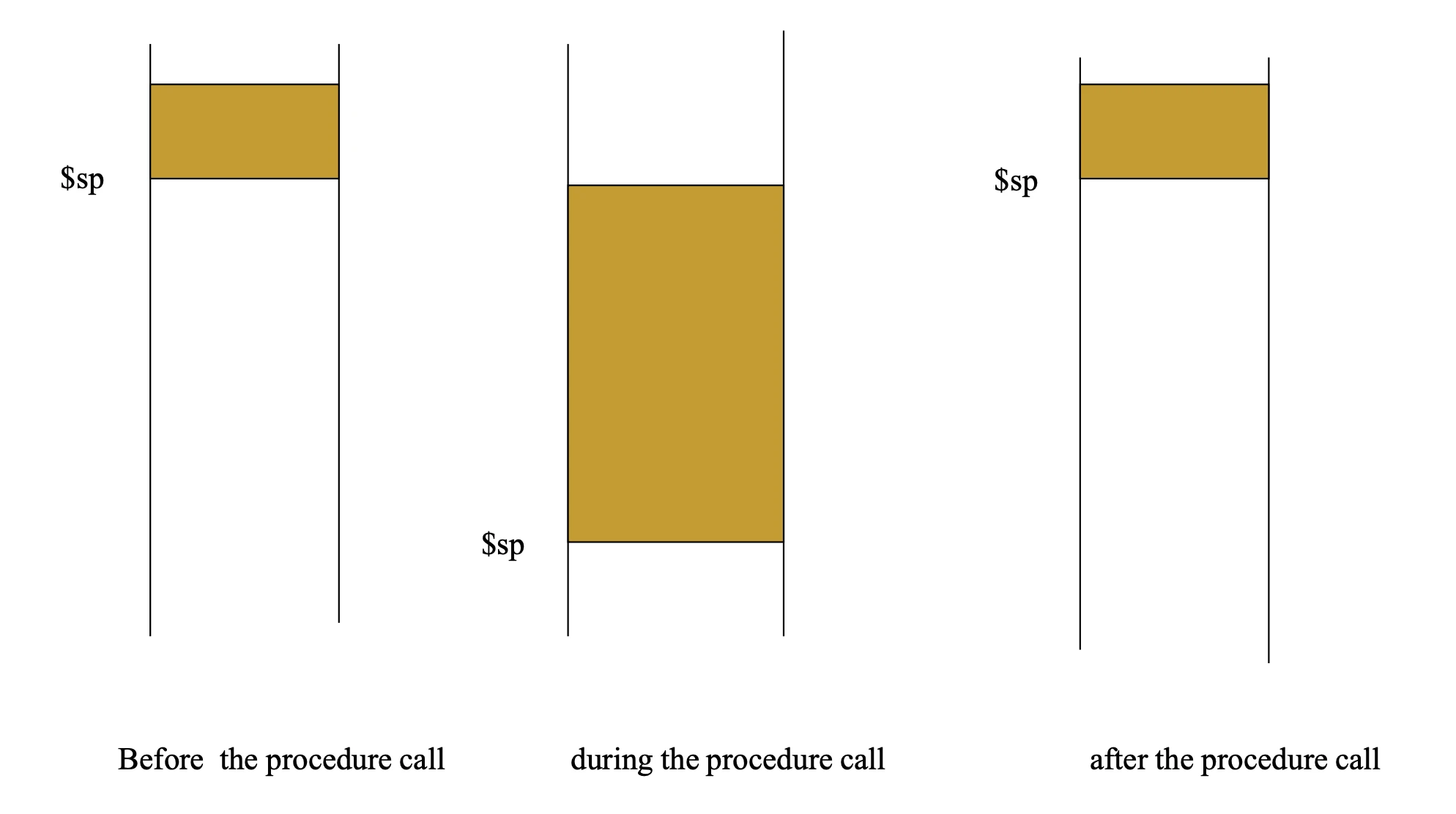
剛剛講到了 allocation of memory 這件事,我們會用 stack 這個 section 來做 procedure call 的 memory 分配
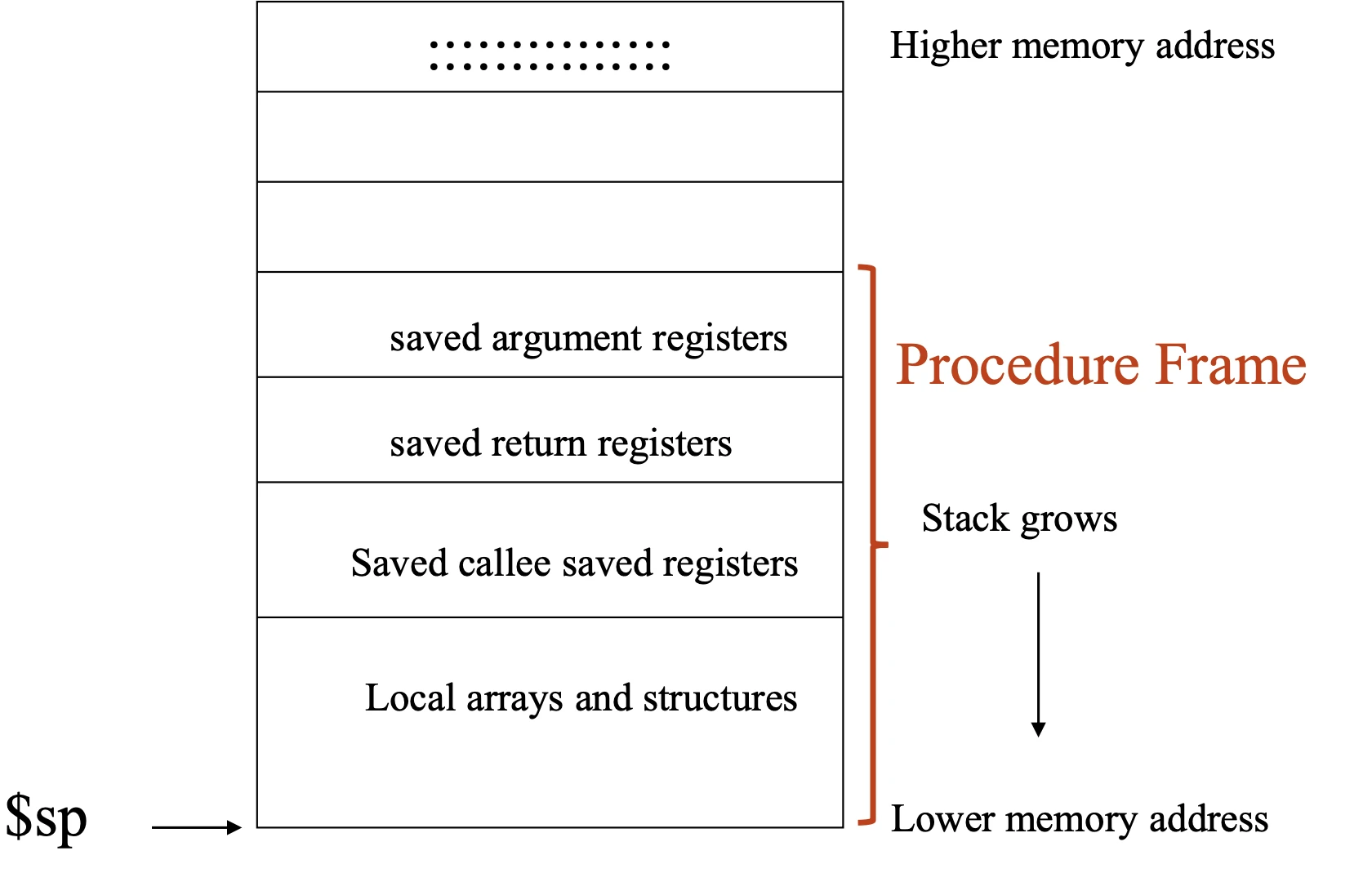
我們會像上面那張圖一樣配置 memory,其中我們會有一個特別的 register,就是 $sp 也就是 stack pointer register,要用來記錄 top of the procedure frame,整個電腦就共用一個 stack pointer register,所以會進行像下面這種 procedure calling 時的轉換
Leaf Procedure#
Leaf Procedure 的意思就是沒有再繼續 call 別的 procedure 的 procedure
#define long long int LL

LL leaf_example(LL g, LL h, LL i, LL j) {
    LL f;
    f = (g + h) - (i + j);
    return f;
}假設這個 procedure 會用到:
- arguments
g, …,jstore 在x10~x13 fstore 在x20- temporary registers 會使用
x5,x6
因為 procedure 執行過程中會修改 x5, x6, x20,所以需要先把它們原本的值 save 到 stack 裡面,等 procedure 結束前再 restore 回去
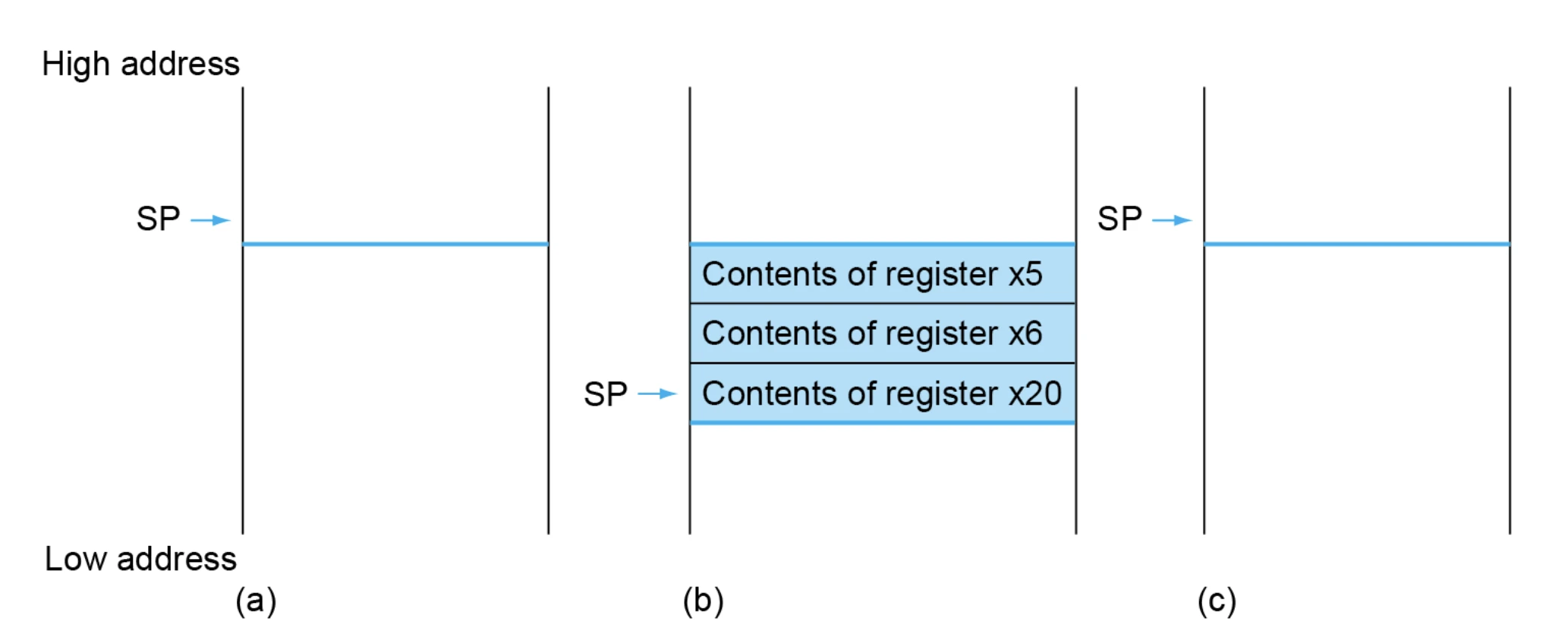
因此我們的 assembly 會長這樣
leaf_example:
    addi sp, sp, -24    # set sp
    sd   x5, 16(sp)     # store
    sd   x6, 8(sp)
    sd   x20, 0(sp)
    add  x5, x10, x11   # operation
    add  x6, x12, x13
    sub  x20, x5, x6
    addi x10, x20, 0    # set return value
    ld   x20, 0(sp)     # restore
    ld   x6, 8(sp)
    ld   x5, 16(sp)
    addi sp, sp, 24
jalr x0, 0(x1) # return如果全部 register 都做 save and restore 的話,這樣 implement 的成本會太大,為了不要讓這件事發生,我們規定了一些 Register convention,也就是 callee 某些 register 會進行保護但某些不會
x5~x7,x28~x31會被用作 temporary register,也就是 callee 不會做 preserved 的x8~x9,x18~x27會被用作 saved register,callee 會保護
當然整個 code 都是他寫的就不用管,自己知道就好,但畢竟有時候是在寫一個 library 還是要管一下別人
從剛剛的 convention 裡面,我們可以簡化掉 x5, x6 的 save
leaf_example:
    addi sp, sp, -24    # set sp
    sd   x20, 0(sp)
    add  x5, x10, x11   # operation
    add  x6, x12, x13
    sub  x20, x5, x6
    addi x10, x20, 0    # set return value
    ld   x20, 0(sp)     # restore
    addi sp, sp, 24
jalr x0, 0(x1) # returnNon-Leaf Procedure#
也就是有 call 別的 procedure 的 procedure,像是 recursive call
long long int fact (long long int n) {
    if (n < 1) return 1;
    else return n * fact(n - 1);
}假設:
nstore 在x10- return value 也放在
x10 x1store return addresssp是 stack pointerx5,x6是 temporary register
fact:
    addi sp, sp, -16
    sd   x1, 8(sp)
    sd   x10, 0(sp)

    addi x5, x10, -1
    bge  x5, x0, L1

    addi x10, x0, 1
    addi sp, sp, 16
    jalr x0, 0(x1)

L1:
    addi x10, x10, -1
    jal  x1, fact

    addi x6, x10, 0

    ld   x10, 0(sp)
    ld   x1, 8(sp)
    addi sp, sp, 16

    mul  x10, x10, x6
jalr x0, 0(x1)一開始先在 stack 上開 16 bytes 的空間:
addi sp, sp, -16
sd   x1, 8(sp)
sd x10, 0(sp)把目前的 return address x1 跟 argument n = x10 save 到 stack。這是因為等等 recursive call fact(n - 1) 會修改 x1 和 x10,所以原本的值必須先留下來。
接下來判斷是不是 base case:
addi x5, x10, -1
bge x5, x0, L1先算
x5 = n - 1如果 x5 >= 0,也就是 n >= 1,就跳到 L1 做 recursive call。
如果沒有跳,代表 n < 1,直接:
addi x10, x0, 1把 return value 設成 1,接著把 stack pop 回去並 return:
addi sp, sp, 16
jalr x0, 0(x1)如果 n >= 1,就進入 L1:
L1:
    addi x10, x10, -1
jal x1, fact先把 argument 改成 n - 1,然後呼叫:
fact(n - 1)fact(n - 1) 回傳之後,結果會放在 x10,所以先把它存到 x6:
addi x6, x10, 0也就是:
x6 = fact(n - 1)接著從 stack 把原本 caller 的 n 和 return address restore 回來:
ld   x10, 0(sp)
ld   x1, 8(sp)
addi sp, sp, 16最後
mul x10, x10, x6得到
x10 = n * fact(n - 1)最後用:
jalr x0, 0(x1)跳回 caller,也就是完成:
return n * fact(n - 1);Memory Layout#
在 OS 裡面我們就學過,我們可以幫 Memory 做 section 的區分
- Text:program code
- Static data:global variables
- ex. static variables in C
- x3(global pointer)initializes to address allowing offsets into this segment
- Dynamic data:heap
- ex.
mallocin c,newin Java
- ex.
- Stack:automatic storage
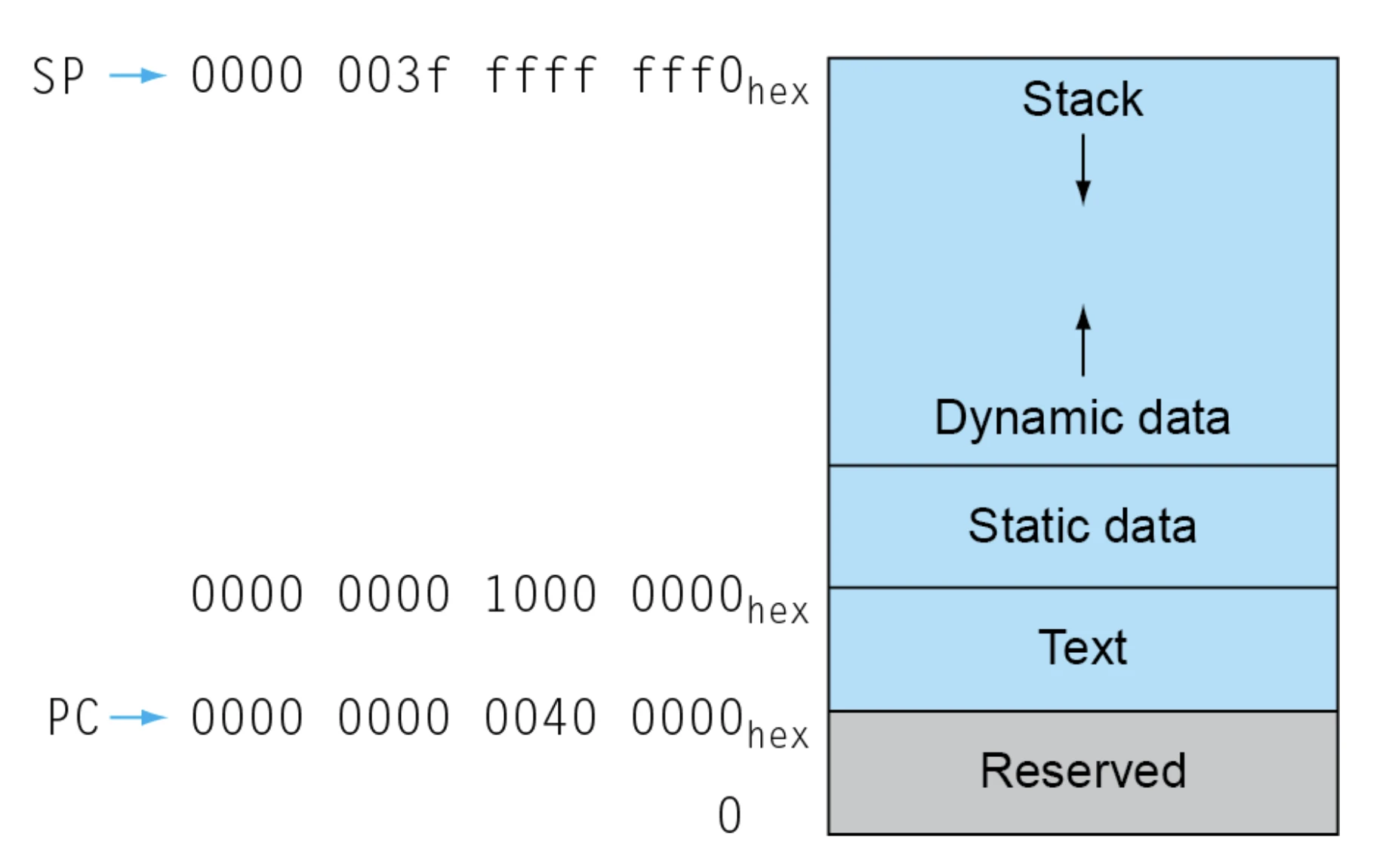
有一個 register 叫做 frame pointer,stack pointer 是指導 top of the stack,那 frame pointer 就是指到 stack bottom of a procedure
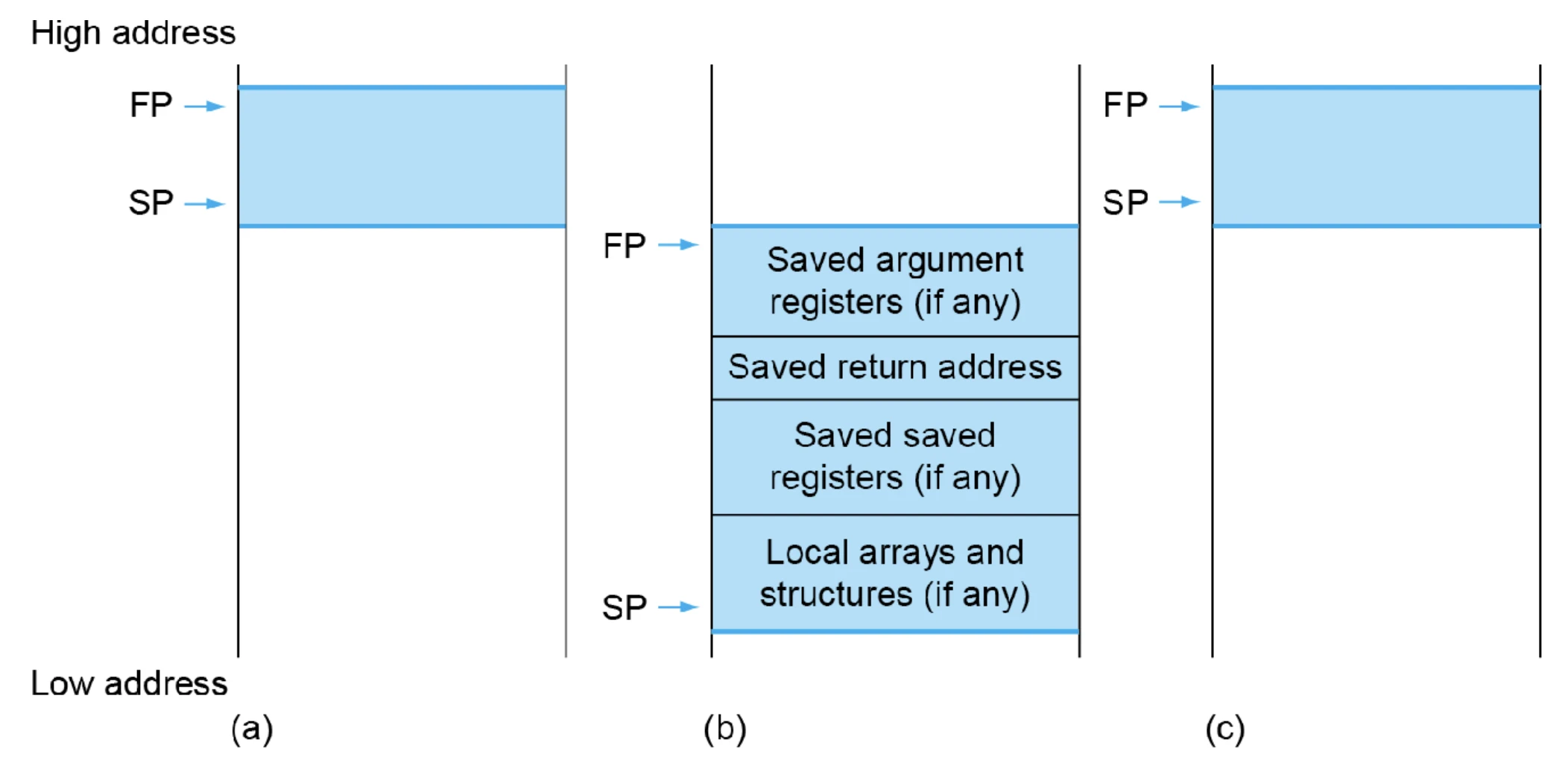
看完這些後我們再看一下 register convention 就可以比較輕鬆理解了
x0              the constant value 0
x1              return address
x2              stack pointer
x3              global pointer
x4              thread pointer
x5-x7, x28-x31  temporaries
x8              frame pointer
x9, x18-x27     saved registers
x10-x11         function arguments/results
x12-x17 function argumentsCharacter Data#
Character data 有兩種 encode 方法
- Byte-encoded character sets 也就是一個 byte 一個 char
- ASCII:128 chatacters(95 graphic、33 control)
- Latin-1:256 characters(ASCII、+96 more graphic characters)
- Unicode:32-bit character set
- used in Java, C++ wide character
- most of the world’s alphabets, plus symbols
- UTF-8, UTF-16:variable-length encodings
Byte/Halfword/Word Operation#
我們做 load, store instruction 我們都需要特別著要他到底需要操作多大的 register
- load byte(1) / halfword(2) / word(4):sign extend to 64 bits in rd(sign extended:最高位是 1 就把前面沒滿的補 1、是 0 就補 0)
lb rd, offset(rs1)lh rd, offset(rs1)lw rd, offset(rs1)
- load byte / halfword / word unsigned:zero extend to 64 bits in rd(全補 0)
lbu rd, offset(rs1)lhu rd, offset(rs1)lwu rd, offset(rs1)
- store byte / halfword / word:store rightmost 8 / 16 / 32 bits
sb rs2, offset(rs1)sh rs2, offset(rs1)sw rs2, offset(rs1)
String Copy#
我們現在想做 string copy 的操作
void strcpy (char x[], char y[]) {
    size_t i; i = 0;
    while ((x[i] = y[i]) != '\0') i++
}假設 argument y 在 x10, x 在 x11
strcpy:
    addi sp, sp, -8        // adjust stack for 1 doubleword
    sd   x19, 0(sp)        // push x19
    add  x19, x0, x0       // i = 0

L1:
    add  x5, x19, x11     // x5 = addr of y[i]
    lbu  x6, 0(x5)        // x6 = y[i]
    add  x7, x19, x10     // x7 = addr of x[i]
    sb   x6, 0(x7)        // x[i] = y[i]
    beq  x6, x0, L2       // if y[i] == 0 then exit
    addi x19, x19, 1      // i = i + 1
    jal  x0, L1           // unconditional jump, next iteration of loop

L2:
    ld   x19, 0(sp)       // restore saved x19
    addi sp, sp, 8        // pop 1 doubleword from stack
jalr x0, 0(x1) // return32-bit Constant#
即便是有 immediate 的 I-format 都只有 12-bit 的儲存空間,如何把一個 32-bit 的 constant load 出來
RISC-V 開發了一種新的 instruction
lui rd, constant;我們想把一個 32-bit 的 constant load 到某個 register 的時候我們就可以
- 把一個 20-bit constant copy 到
[31:12]這個區間 (lui) - 用
addi把剩下的 bit 塞到最後面
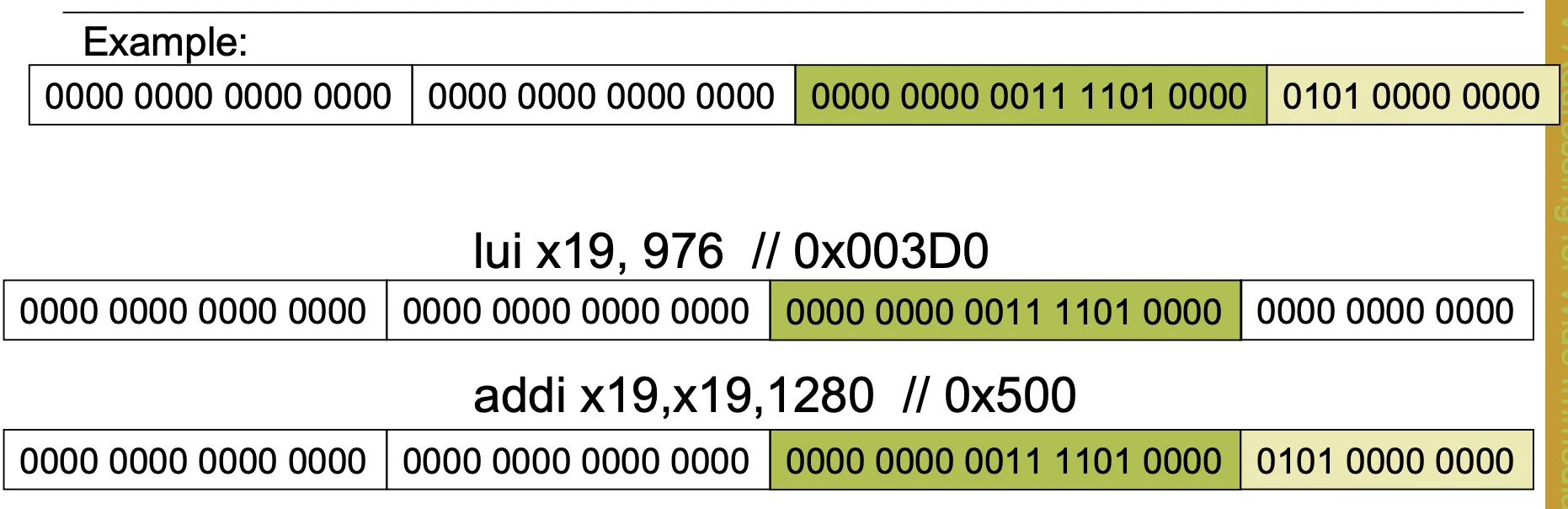
為此 RISC-V 又開發了 U-type instruction

Encoding for Control flow instruction#
SB-format#
如果是 branches 操作 bne, beq,我們會用 SB-format

這樣的 imm 排法是為了 datapath 的方便,比如說我想跳去 2000 這個位置,我就需要跳到 0 0111 1101 0000 那放的方法就是

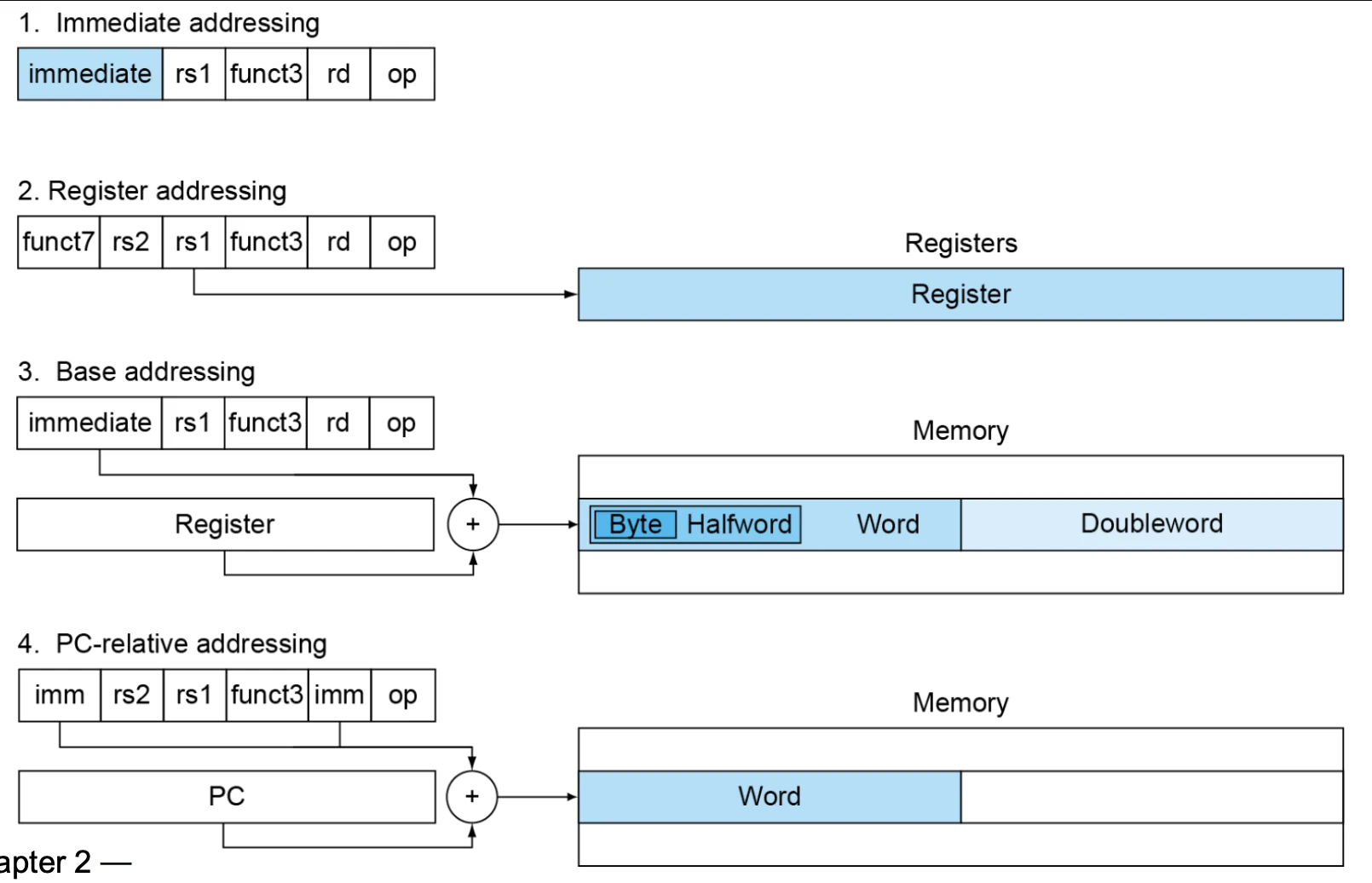
這樣的 addressing 方式叫做 PC-relative 的 addressing,計算方法是
branch target 至少 2-byte aligned,所以 RISC-V B-type branch 不存 imm[0],因為 imm[0] 永遠是 0
UJ-format#
如果是 unconditional jump 操作 jal, jalr,我們會用 UJ-format

也是用 PC-relative addressing,我們需要很多

Branching Far Away#
SB-format 只能跳到 12-bit 以內,我們需要想辦法 branch 到 12-bit 之外,通常這時候我們會改寫 code
相等的話我們就要跳到 L1
beq x10, x0, L1我們可以改寫成不相等的話就跳到 L2(繼續執行),相等的話就執行 jal,因為 jal 有 20-bits 比較多
    bne x10, x0, L2
    jal x0, L1
L2: Long Jump#
另外一種方法叫做 long jump,我們知道他的 32-bits absolute address,我們剛剛介紹了 32-bits 的 constant loading method,所以我們可以
lui x8, address[31:12];
jalr x0, address[11:0](x8);我們先把前 20-bits 的 address 用 lui 塞進 x8,然後用 jalr 做後面的 addressing jump
Synchronization In RISC-V#
RISC-V 也可以做到 Synchronization 或是說 Data Sharing,之前 OS 說過需要有 lock 的概念
P(1)
    Acquire Lock;
    If Lock = 0
        enter critical section;
Release Lock;P(2)
Acquire Lock;
If Lock = 0
enter critical section;
Release Lock;那我們來看看有沒有辦法用現在學過的 Instruction 做到這件事,最簡單的 lock 改念就是把某個 register 的 val 跟 memory 裡面的 val 交換
lock = 0:沒有人拿lock = 1:已經有人拿
最直覺我們會把 code 寫成
lockit:
    lw    x2, 0(x1)      # read lock
    sw    x4, 0(x1)      # lock = 1
bne x2, lockit但這樣不安全,因為 lw 和 sw 是兩個分開的 instruction,假設一開始:
lock = 0兩個 processor 可能同時:
P1: lw → 讀到 0
P2: lw → 也讀到 0
P1: sw → 寫成 1
P2: sw → 寫成 1結果兩個人都以為自己拿到 lock,所以問題是 get lock 跟 check lock 應該要是一個 atomic operation
Conditional Store/Load#
所以我們引入 conditional store and load
lr.d x10, (x20);做兩件事:
- 把
x20指向的 memory value load 到x10 - 對這個
x20memory address 做一個 reservation,也就是讓 CPU 知道我們想關注這個 register(就是把他當 lock 的意思)
接著:
sc.d x11, x12, (x20);嘗試把 x12 寫進 memory:
- 如果從
lr.d到現在,mem[x20]沒有被其他 processor 改過,那 store 成功,想 store 的東西會到mem[20],x11 = 0 - 如果被改過,就代表store 失敗,
x11 != 0
Ref: https://www.cs.sfu.ca/~ashriram/Courses/CS295/assets/notebooks/RISCV/RISCV_GREEN_CARD.pdf ↗